
PitchBob.io Review: An AI Co-Pilot for Founders Who Hate the Blank Page
By: AI Collection
At a glance

PitchBob io
PaidEvery founder knows the moment: a blinking cursor, an empty slide, and a head full of an idea that refuses to line up into something an investor would sit through. PitchBob.io is built squarely around that moment. Instead of handing you another template to fill in, it opens a chat, asks questions, and turns the back-and-forth into a pitch deck, a business plan, and a stack of investor documents. I spent time with the product pages, its public reviews, and the independent coverage to see whether the conversation actually leads somewhere useful.
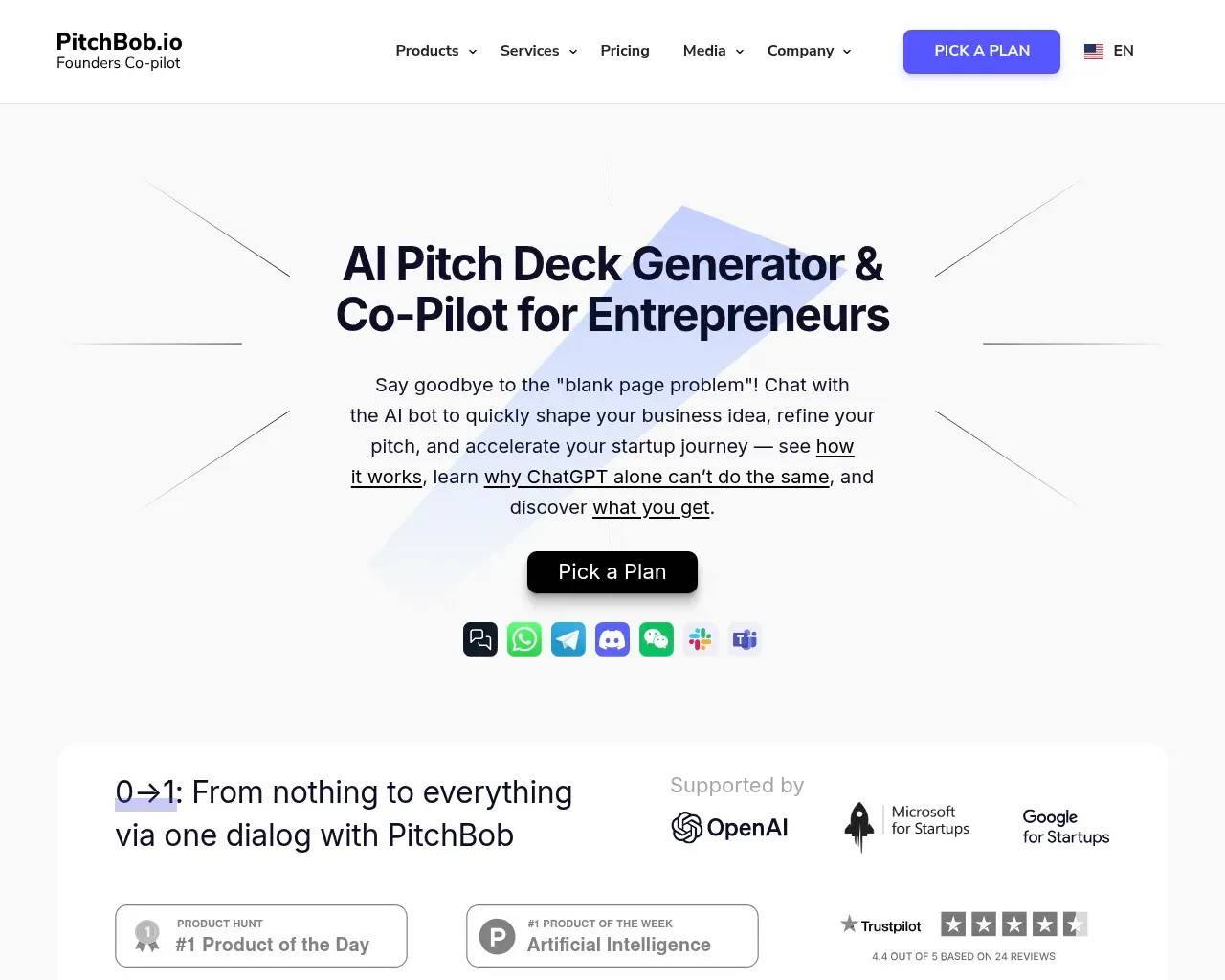
A chat that ends in an investor pack
The core idea is simple. You talk to a bot — on the web, or through Telegram, WhatsApp, Discord, Slack, WeChat, or Teams — and describe your business. PitchBob asks the kind of questions a mentor would, then generates the artifacts founders usually dread assembling: a slide deck, a one-page summary, an elevator pitch, an investor letter, a lean canvas, and a business-model canvas. It supports voice as well as text, translates the output into other languages, and, in its own words, "remembers and learns" as you keep working.
That framing matters. Plenty of tools will spit out slides from a prompt. PitchBob positions itself as a co-pilot that stays with you from the messy idea stage through fundraising, which is a different promise than a one-shot generator.
What's actually in the toolkit
The catalog is broader than "pitch deck maker." PitchBob's own llms.txt lays out the full menu: the conversational AI Co-Pilot, a Business Plan Generator, a VC Matching Tool, a founders' agreement and equity tracker, a VC analyst for deal flow, and a white-label version aimed at accelerators and enterprises. There's also a human layer — pitch-deck consultants, startup feedback, grant help, and a mentorship-and-tracking program — sitting alongside the automated tools.
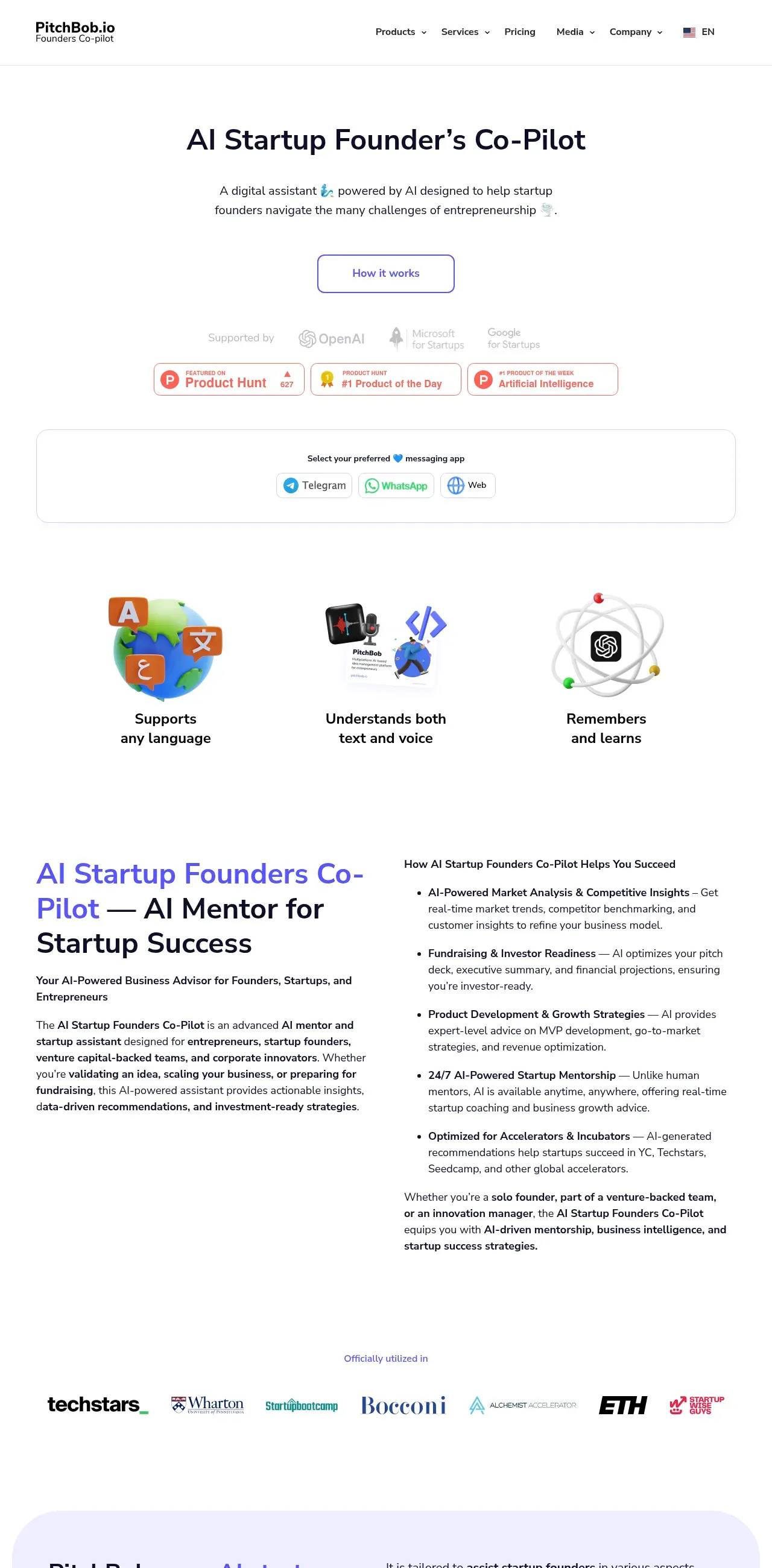
The Co-Pilot is the centerpiece. Its product page describes real-time market and competitor analysis, fundraising and investor-readiness prep, product and growth guidance, and "24/7" startup coaching — pitched as a substitute for a mentor you'd otherwise struggle to book.
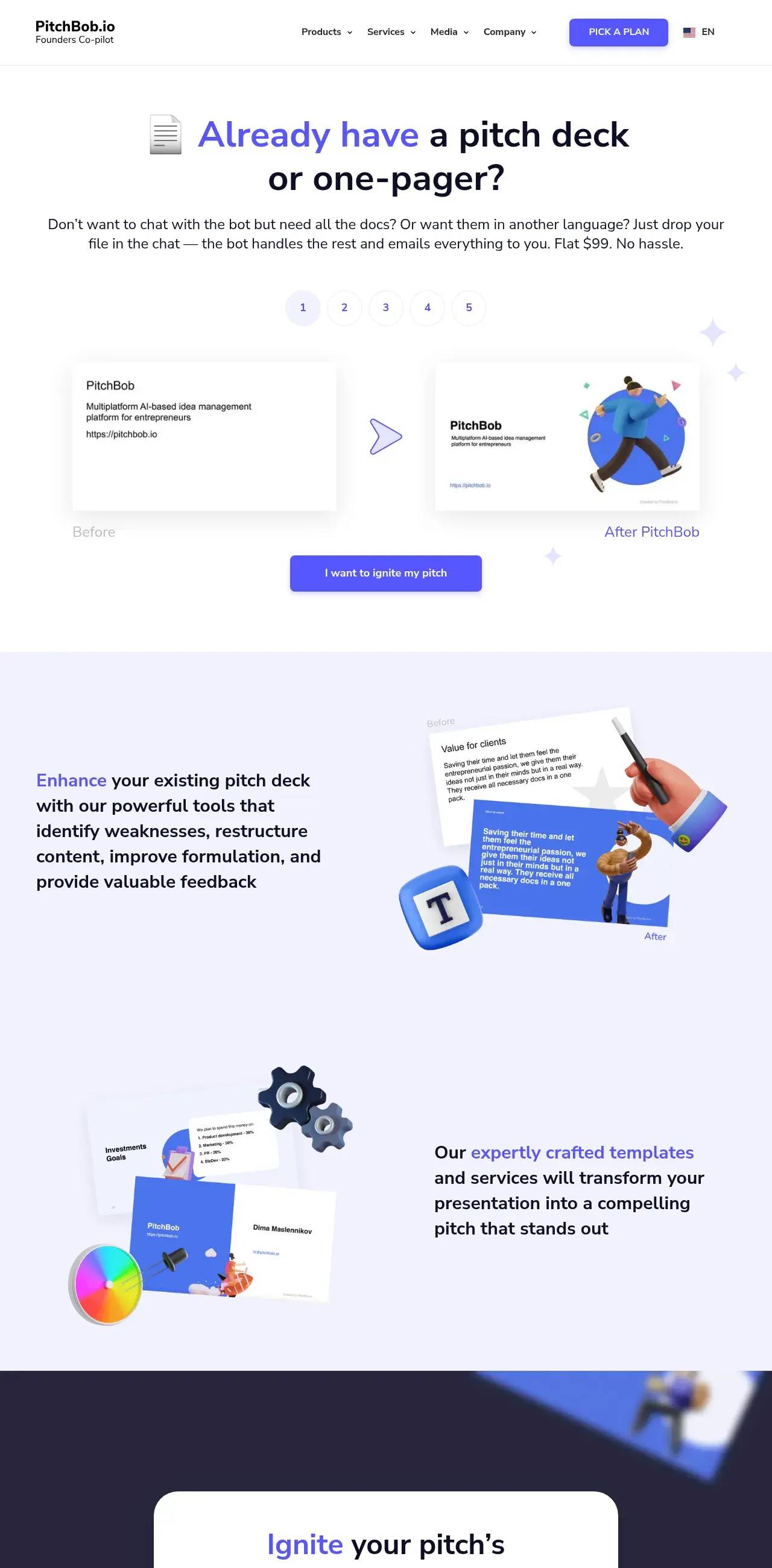
If you already have a deck, there's a separate path. Drop your existing file or one-pager into the chat and PitchBob will analyze the weaknesses, restructure the content, rework the formulation, and email the polished documents back to you. The company prices that as a flat, one-time job.
The credibility signals
PitchBob does not lack for logos. Its site lists support from OpenAI, Microsoft for Startups, and Google for Startups, and the Co-Pilot page points to use inside programs like Techstars, Wharton, Startupbootcamp, Bocconi, and Alchemist Accelerator. The homepage claims more than 60,000 entrepreneurs have run their ideas through it (the counter read 60,183 as of early September 2025) and carries a Product Hunt "#1 Product of the Day" badge.
Independent coverage is mixed but not dismissive. The startup blog Feedough gave it a favorable write-up, calling out that — among the tools it tested — PitchBob "was the only product that had a copilot feel," engaging with the startup and its materials over time rather than acting like a one-off chatbot. That, more than the slide output itself, is the product's real differentiator.
Pricing: mostly pay-once, with a few subscriptions
PitchBob's pricing leans toward one-time payments, which is unusual in a category full of monthly seats. On the homepage, the zero-to-one generation flow starts from a one-time fee (advertised from around $29.90, with tiered one-time plans climbing toward the $80 range as you add editable PPTX files, financial models, accelerator applications, and an investor database). The "improve my existing deck" service is a flat one-time charge (listed at $99). The ongoing Founders Co-Pilot is the subscription piece, starting around $19.90 per month, and white-label deals begin at about $99 per month.
One caveat worth stating plainly: the exact numbers move around. Different listings and review sites quote different tiers and discounts, so treat any figure — including these — as a starting point and confirm the current price on the site before you buy.
Where it falls short
This is where an honest review has to slow down. For all the polished marketing, PitchBob's reception from paying users is uneven. Its public profile on Trustpilot sits at a "Poor" 2.4 out of 5 — a notable gap from the higher score the site's own embedded widget shows. Recurring complaints across Trustpilot and Product Hunt reviews cluster around a few themes: generated documents that needed heavy cleanup (awkward structure, spelling errors, off-topic content), occasional technical glitches like sessions resetting, and slow or unsatisfying customer support. Some buyers also reported friction getting a refund.
There's a privacy wrinkle, too. A few reviewers were unhappy to find their pitch material surfaced publicly after generation, and felt that crossed a line. If your idea is sensitive, that's worth asking about before you start feeding it into the chat.
Read together, the signal is consistent: PitchBob is good at getting you from nothing to a credible first draft fast, but the output is a starting point, not a finished, investor-ready deck. Plan to edit, fact-check, and design-polish before anything goes in front of a check-writer.
Who should try it
PitchBob makes the most sense for first-time founders, students, indie hackers, and corporate innovators who are stuck at the structuring stage and want momentum more than perfection. The conversational format genuinely helps when you can't yet articulate the business, and the one-time pricing is friendly to someone who needs a deck for one round, not a permanent subscription. Accelerators and universities are a second natural fit, via the white-label and cohort tooling.
If you already write tight decks, have a designer, or are guarding confidential details closely, the value is thinner — you'd mostly be paying for a head start you may not need, and inheriting the editing work anyway. Used with clear eyes about what it is — a fast, conversational first-draft engine with a genuine co-pilot streak — PitchBob can save a stuck founder a lot of staring at that blinking cursor.
Sources consulted
- PitchBob.io homepage — product positioning, the blank-page framing, supported-by and used-by claims, the 60,000+ founders counter, Product Hunt badge, and entry-level pricing.
- PitchBob llms.txt — the full catalog of products and services (Co-Pilot, business plan, VC matching, equity tracker, white-label, and the human services).
- AI Startup Founder's Co-Pilot — the Co-Pilot's stated capabilities and the accelerators/universities it cites.
- Improve Pitch Deck — the upload-and-rework flow and its flat one-time pricing.
- Feedough — PitchBob.io startup review — independent assessment and the "copilot feel" differentiator.
- PitchBob.io on Trustpilot — independent user ratings (2.4/5, "Poor") and recurring complaints.
- PitchBob.io on Product Hunt — launch reception and user reviews.
Published on: June 5, 2026
Looking for alternatives to PitchBob io? See all PitchBob io alternatives →
Have an AI tool of your own? Submit it below and get a free, in-depth product review article — just like this one.
Add your AI tool in seconds
Paste your URL and we'll draft the listing. You review and edit every field before submitting.
More Product Reviews:

By: AI Collection
By: AI Collection