
THEO Growth Review: A Positioning Brain for the AI Assistant You Already Use
By: AI Collection
At a glance

THEO: Context-aware Strategic Co-Pilot
PaidTHEO Growth Review: A Positioning Brain for the AI Assistant You Already Use
If you run a brand or an agency, you've probably had this moment: you open ChatGPT to draft a campaign angle for a client, and before it gives you anything useful you spend ten minutes re-explaining who the client is, what they sell, who they're up against, and why their last positioning didn't land. Do that across a dozen accounts and the re-briefing becomes its own part-time job.
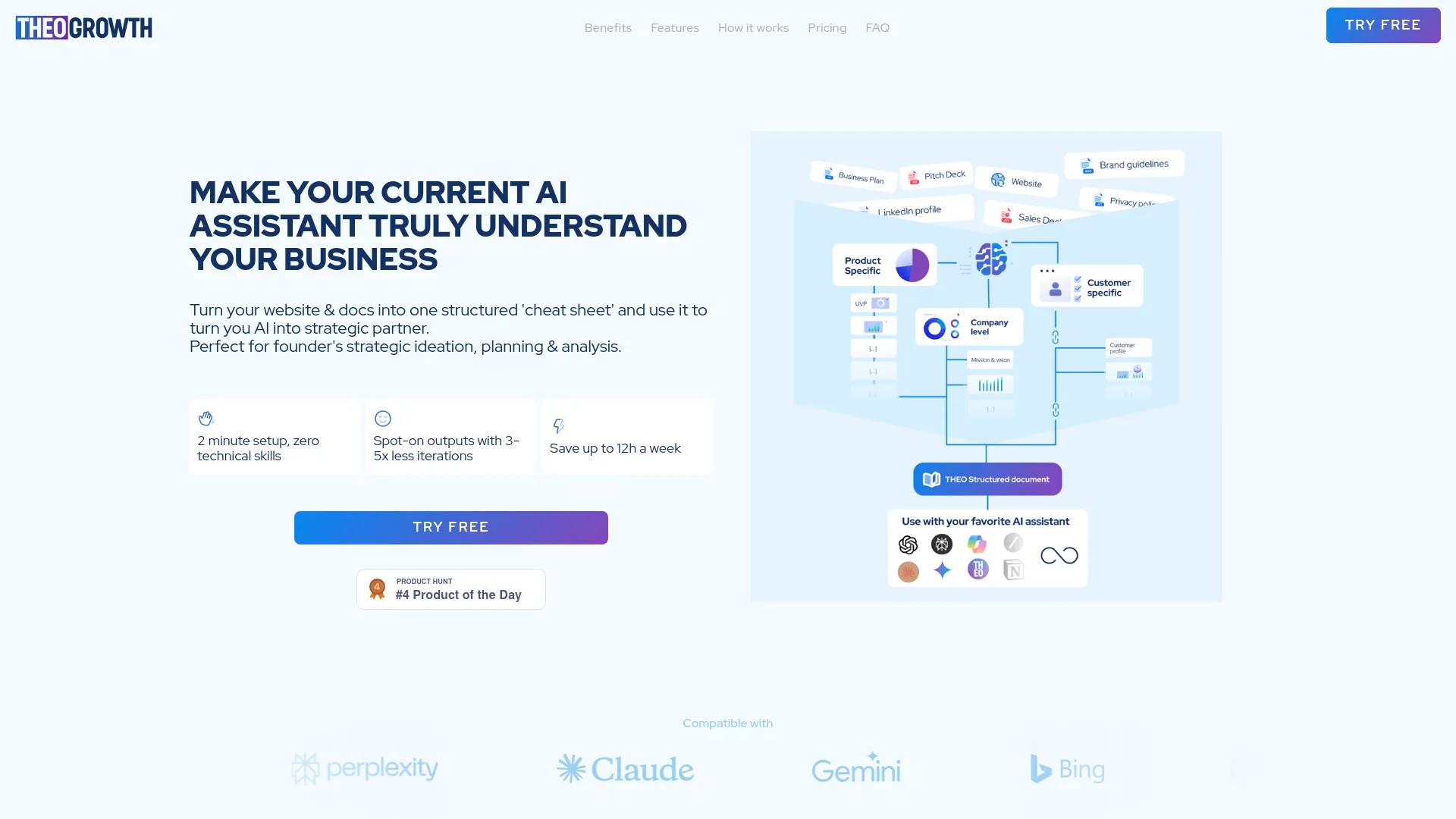
THEO Growth is built squarely at that friction. Rather than being another chat window, it's a positioning-intelligence layer that turns a company's public footprint into structured context your existing AI assistant can actually reason with.
What THEO actually does
THEO's pitch is narrow on purpose: it's a "competitive brand positioning intelligence tool that explains why and how competitors position themselves," aimed at brand strategists and agencies rather than at marketers in general. You point it at a brand — in practice, a website link plus a few uploaded documents — and it produces a structured read of where that brand sits in its category and how its rivals are framing themselves.
The output is organized around six recurring lenses: company foundation, product and solution, customer insights, market landscape, commercial strategy, and brand and communication. On Product Hunt the team describes the underlying method as mapping "category landscapes from the brand's perspective," evaluating competitive relationships through frameworks that combine messaging analysis with operational signals. The practical payoff they advertise is research depth that "would usually cost thousands and take days" compressed into hours.
What makes the tool legible is that it doesn't try to replace ChatGPT or Claude. It feeds them. THEO's structuring step produces context you carry into the AI assistant you already pay for — which is exactly how its early reviewers describe using it.
What early users actually say
This is where THEO is more convincing than most self-published feature lists, because the few independent reviews line up with the product's stated job.
On Product Hunt, THEO holds a 4.6 rating across five reviews with 486 followers. The reviews are short but specific. One reviewer, Dāvis Cinītis, used it to build a partnerships roadmap and said it helped him put the plan "on paper" in about 30 minutes, adding he was "most impressed at how much context it pulled from just giving it my company's website link." Another, Elise Lock, framed it as a ChatGPT upgrade: "I don't have to spend time telling about my agency, I can get what I want with simple prompts."
That theme — stop re-explaining yourself to the model — is the most consistent signal I found. It's worth flagging that one of the five Product Hunt reviews is from the company itself (founder Alise Plotova), so the genuinely independent sample is smaller than the headline number suggests.
The product's history checks out too. Product Hunt records an original launch ("THEO — Making AI truly understand your unique business nuances") on November 11, 2024, followed by a "THEO 2.0 — Business Context Engineering Made Simple for Marketing Teams" launch on July 24, 2025, which is a reasonable sign of continued development rather than a one-and-done release. The founder also posted it to Hacker News on January 31, 2025, though that submission drew essentially no discussion — a fair indication that THEO is still a small, under-the-radar tool rather than a widely vetted one.
Pricing: pay per analysis, not per seat
THEO's pricing model is the most unusual thing about it, and worth understanding before you sign up expecting a typical SaaS subscription. The entry option listed in our directory is a "Basic Structuring" tier at $10 on a pay-per-structuring basis — you're buying an analysis run, not a monthly seat. That tier covers uploading up to three documents, roughly 25 sections or data points per run, web context mining, gap identification, and compatibility with the major AI assistants.
A credit-style, pay-as-you-go model can be genuinely friendly for agencies with lumpy demand — you pay when you onboard a new client or pitch a new account, not every month regardless. It can also get expensive if positioning work is your daily bread, so it's worth doing the arithmetic against your actual cadence. THEO's own site advertises larger plans and team-oriented packaging, so confirm the current tiers and per-run limits directly with them before committing.
Who it fits — and who it doesn't
THEO makes the most sense for a specific buyer: a brand strategist or agency that already lives inside ChatGPT or Claude and is tired of re-establishing context for every client. If your work is repetitive positioning analysis across multiple brands, the "structure once, prompt many times" workflow is the clear draw, and the vendor leans into that with marketing claims of 400+ agencies saving 20+ hours a month (their figures, not independently verified).
It's a weaker fit if you don't already use an AI assistant as part of your workflow — THEO is a context layer, not a standalone analysis dashboard, so its value is tied to feeding another tool. It's also a thinner bet if you need the reassurance of a long, public track record: with only a handful of reviews and little community discussion, you're evaluating a young product largely on a short trial of your own.
The honest summary: THEO is a focused, plausible answer to a real and specific pain, with early reviews that match its promise — but a small enough footprint that the smart move is to run one paid structuring on a brand you know well and judge the output against what you'd have produced by hand.
Sources consulted
- THEO Growth on Product Hunt — rating (4.6/5, 5 reviews), follower count, launch dates, product description, and the user reviews quoted above.
- Hacker News submission, Jan 31 2025 — launch timing and the tool's "make your AI assistant understand your business" framing; minimal traction signal.
- THEO Growth (vendor site, via web search) — vendor's stated "400+ agencies / 20+ hours saved" claims and cross-assistant (ChatGPT, Claude) positioning.
- AI Collection directory record — product description, category, and the $10 "Basic Structuring" pay-per-structuring pricing detail.
- Wayback Machine — confirmed archived snapshots consistent with a 2024 launch.
Published on: June 1, 2026
Looking for alternatives to THEO: Context-aware Strategic Co-Pilot? See all THEO: Context-aware Strategic Co-Pilot alternatives →
Have an AI tool of your own? Submit it below and get a free, in-depth product review article — just like this one.
Add your AI tool in seconds
Paste your URL and we'll draft the listing. You review and edit every field before submitting.
More Product Reviews:

By: AI Collection