
Riku.AI Review: A No-Code Way to Build AI Apps Across 40+ Models
By: AI Collection
At a glance

Riku
PaidRiku.AI Review: A No-Code Way to Build AI Apps Across 40+ Models
If you have ever wanted to ship a working AI feature — a branded chatbot, a repeatable content generator, an image tool for your team — without opening a code editor, you have probably hit the same wall: every model lives in its own dashboard, with its own quirks, and stitching them together is a project in itself. Riku.AI was built to flatten that. It positions itself as a single no-code workspace where you build, test, and deploy AI apps across more than 40 large language models.
This review covers what Riku actually does, what it costs, how its users rate it, and a few things worth checking before you wire it into a workflow.
One workspace, many models
Riku's founding idea is refreshingly practical. As the company tells it, the LLM ecosystem became fragmented — dozens of models from different labs, with no central place to save prompts or compare outputs. Riku started as a "central playground" to swap models in and out and keep prompts in one vault, then grew into a platform for building and deploying.
In practice that means you write a prompt once and run it against any of the 40-plus models Riku connects to, comparing results instead of juggling separate tabs. For anyone who has hunted for the right model by trial and error, having that experimentation in one place is the headline feature.
What you can build
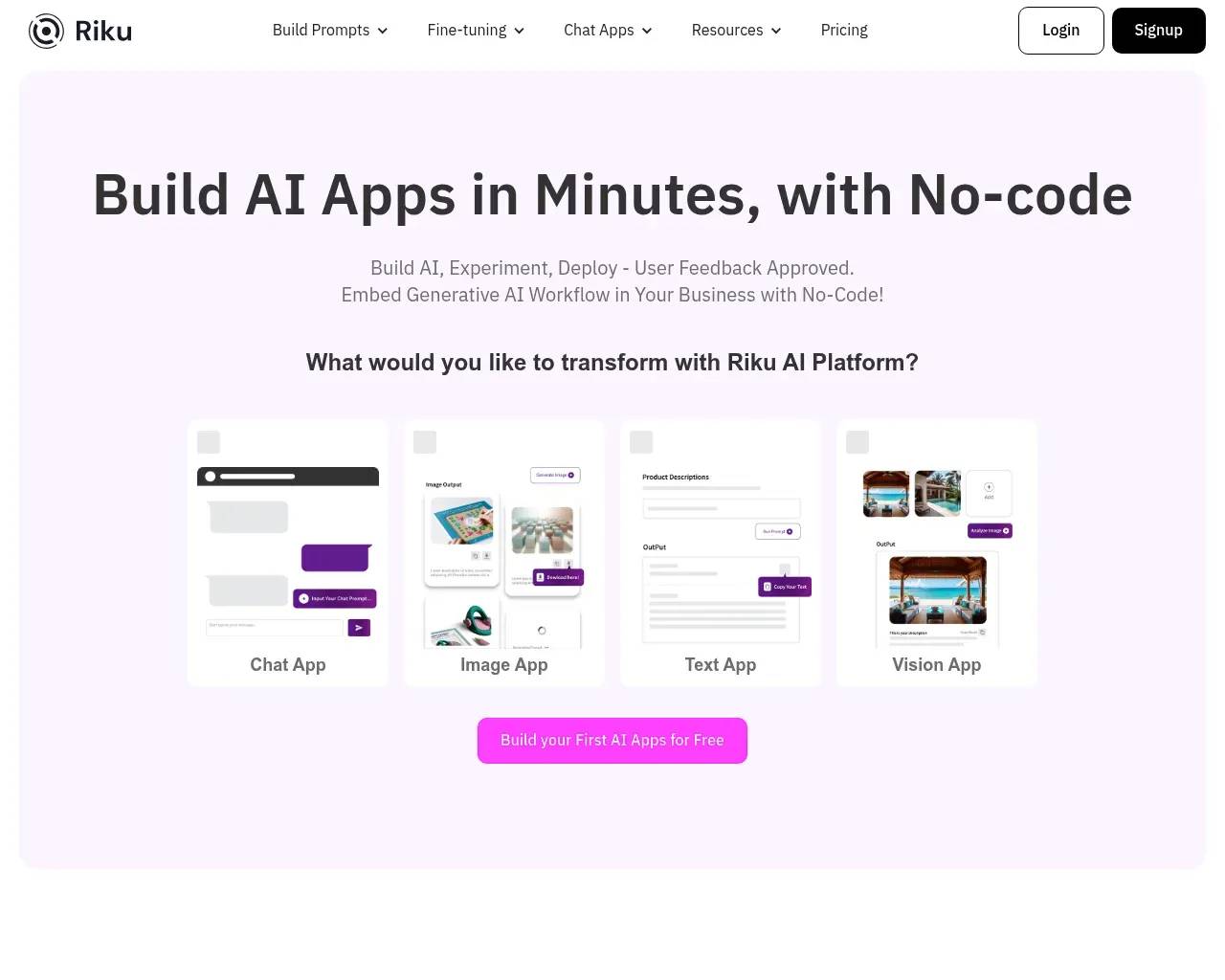
Riku organizes the work into a few app types you assemble visually:
- Chat apps — conversational agents you can use internally, share with a team, password-protect, or publish.
- Text apps — fixed-structure generators for content you produce repeatedly, so quality stays consistent.
- Image apps — your own image generator built on current image models.
- Vision apps — tools that analyze one or more images and return text insights.
A nice touch is Public Share Links: each prompt can become its own branded landing page — your colors, logo, and welcome text — that anyone with the password can use to generate output. It is essentially a way to hand a custom mini-tool to clients or teammates without giving them your account.
No-code fine-tuning and datasets
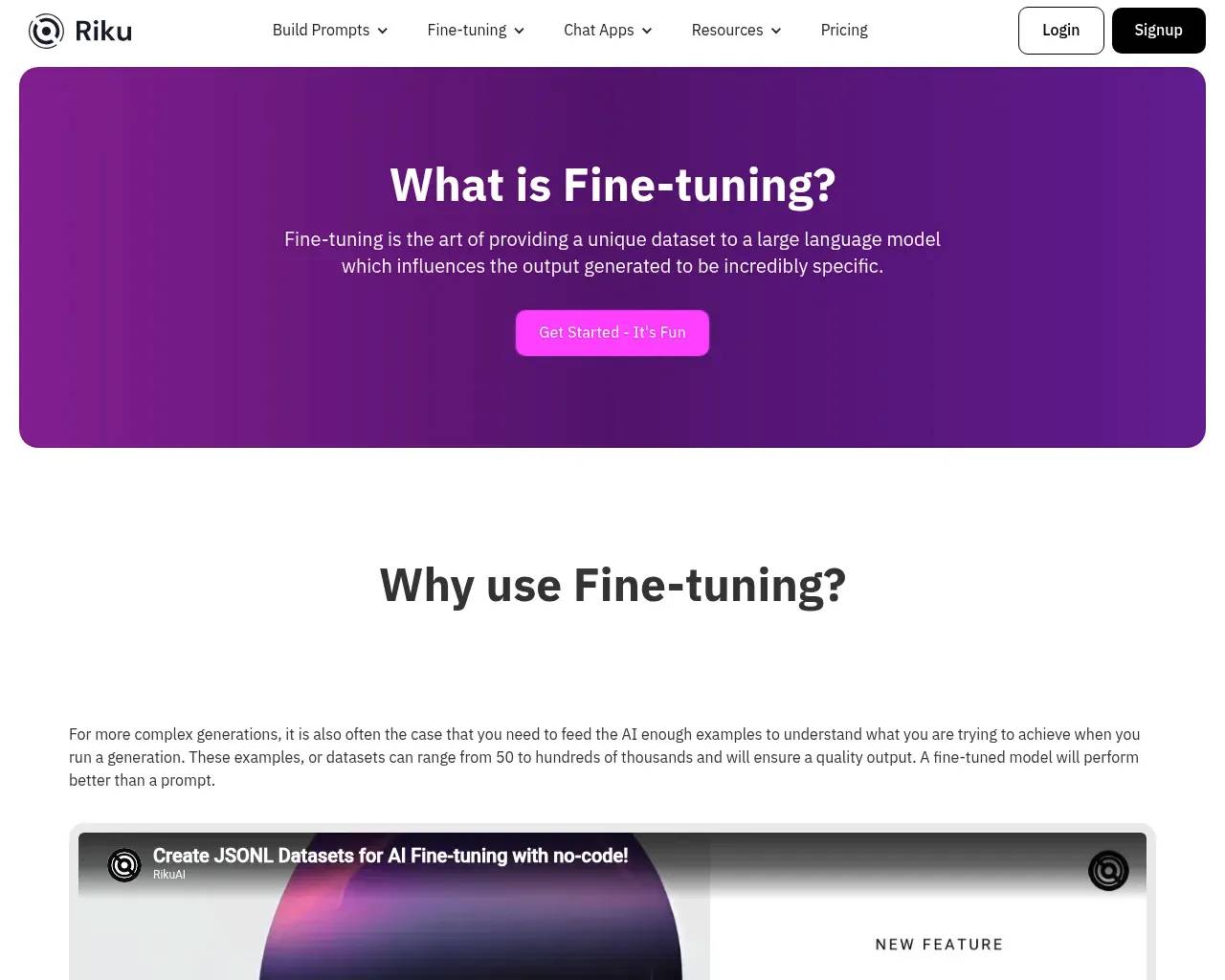
Beyond prompting, Riku leans into fine-tuning — usually the most code-heavy part of working with models. It lets you build JSONL datasets and train your own models through a guided format rather than a script. The FAQ frames it plainly: fine-tuning takes a dataset and produces a model, and Riku handles the backend so you do not have to. The annual plans bundle this with usage of an open-source model (Mistral 7B is the one named) plus a pool of API credits.
Where it plugs in
A builder is only useful if its output goes somewhere. Riku exposes a single standardized API endpoint that returns results from any connected model in a consistent shape — handy if you have been burned by every provider formatting responses differently. It also connects through the familiar no-code automation tools: Zapier, Make, Google Sheets, Pabbly, and Airtable. One verified user singled out the Google Sheets integration as a real time-saver.
Pricing
Riku keeps the tiers simple, and every plan comes with a five-day free trial:
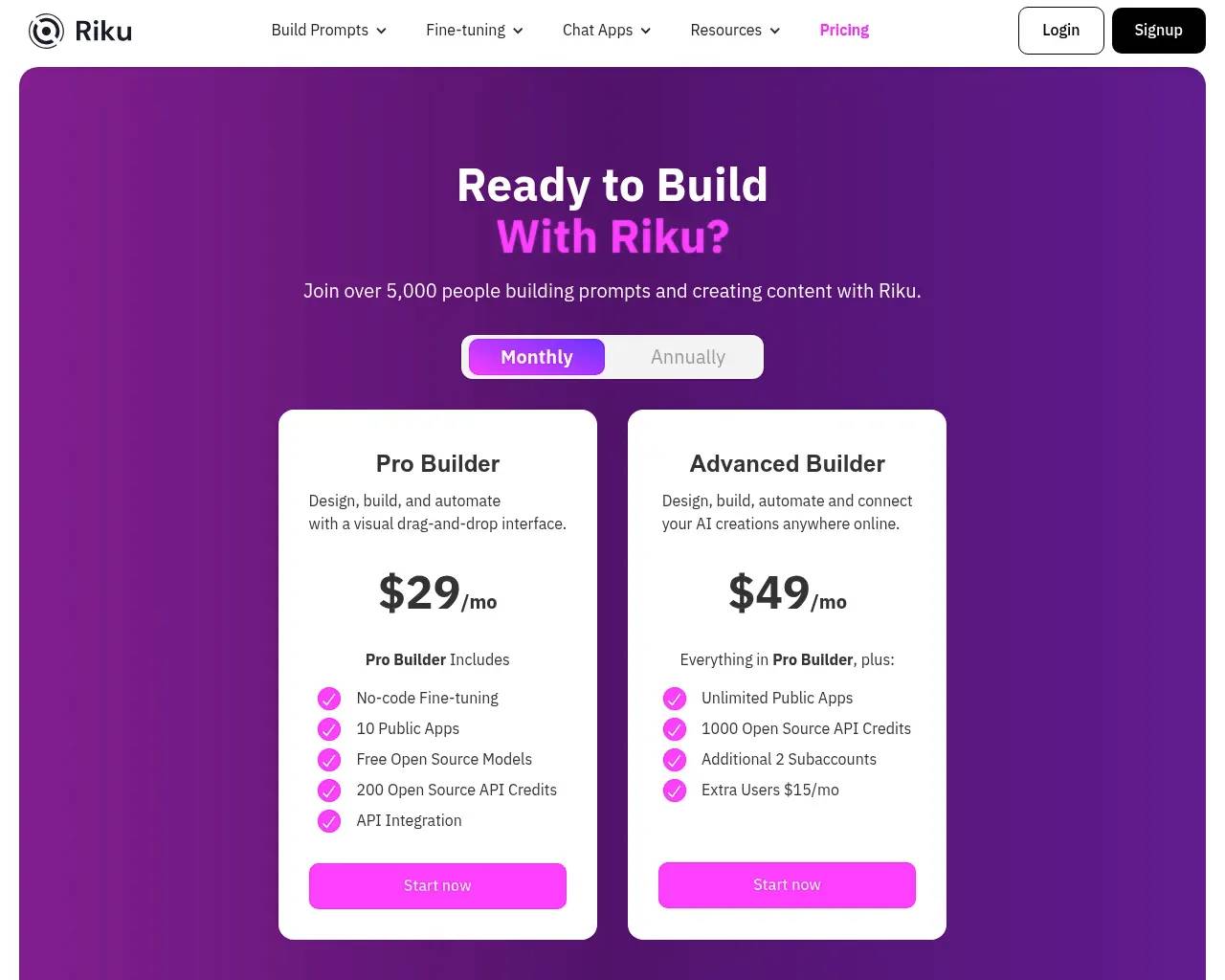
- Pro Builder — $29/mo (or $25/mo billed annually): no-code fine-tuning, 10 public share links, open-source model usage, 200 API credits, and API integration.
- Advanced Builder — $49/mo (or $40/mo billed annually): everything in Pro plus more public apps, 1,000 API credits, 500 image credits, and two extra subaccounts. Additional users are $15/mo.
There are no refunds; the five-day trial is the safety net, and the team makes a point of letting you cancel without friction. Non-profits and educators are pointed to the contact form for case-by-case help.
What users say
Riku reached a lot of people through an AppSumo lifetime deal, which left a sizable review trail. Across 97 ratings it averages 4.9, with 94 of those at the top score. The recurring themes: the prompt-building interface is genuinely approachable, the community prompt library gives you a head start, and the founder, Stuart Lansdale, is unusually hands-on — buyers repeatedly mention his walkthrough videos and direct replies to their questions. Being able to take a prompt built for one model and run it on another "beautifully," in one reviewer's words, is the kind of thing that turns a trial into a subscription.
The flip side shows up in those same reviews, and it is worth taking seriously.
Things to weigh
- Check the current model lineup for your use case. The public site has not been republished since November 2024, and the models named across it skew to an earlier wave (Mistral 7B as the open-source option, with names like AI21 and GPT-J appearing in older user reviews). Since "40+ models" is central to the pitch, confirm the specific models you need are available and current before you commit.
- Language coverage is English-first. A verified reviewer found limited support for non-English work — they could not get a consistent Spanish model — and the founder acknowledged that most LLMs are built English-first, pointing to a couple of models with native non-English options as workarounds. If you build in other languages, test that path during the trial.
- No refunds. The five-day trial is your only evaluation window, so plan to actually use it.
Who it's for
Riku fits solo founders, marketers, small teams, and educators who want to put AI to work without hiring a developer — people who value breadth (many models, many app types, easy sharing) and a gentle learning curve over bleeding-edge model access. Developers will appreciate the unified API; teams will like the share links and subaccounts. If your work hinges on the very latest frontier models or heavy non-English generation, trial those specific needs first.
The short version: Riku is a well-liked, genuinely no-code way to build and deploy across many models, strongest for experimentation, content workflows, and sharing custom tools. Spend the five free days confirming the models and languages you need are covered, and you will know quickly whether it belongs in your stack.
Sources consulted
- Riku.AI homepage — product positioning, app types, model count, integrations
- Riku.AI pricing & FAQ — plan tiers, trial, refunds, fine-tuning and API details, user count
- Riku.AI — Our Story — origin and product vision
- Riku.AI reviews on AppSumo — verified ratings, user themes, and the non-English limitation
Published on: June 20, 2026
Looking for alternatives to Riku? See all Riku alternatives →
Have an AI tool of your own? Submit it below and get a free, in-depth product review article — just like this one.
Add your AI tool in seconds
Paste your URL and we'll draft the listing. You review and edit every field before submitting.
More Product Reviews:
By: AI Collection
