
Chat Data Review: A Support-Chatbot Builder Built Around Backends and HIPAA
By: AI Collection
At a glance

Chat Data
Search "AI chatbot for my website" and you'll drown in tools that all promise the same thing: point us at your docs, we'll train a bot, paste a snippet, done. Chat Data starts from that same premise — upload your content, get an agent, embed a widget — but the parts that actually matter for a buyer are the ones underneath: how much of the stack you control, where your data lives, and whether the thing can handle a regulated workflow without falling over. On those questions it has more to say than most of its competitors.
What it is, in plain terms
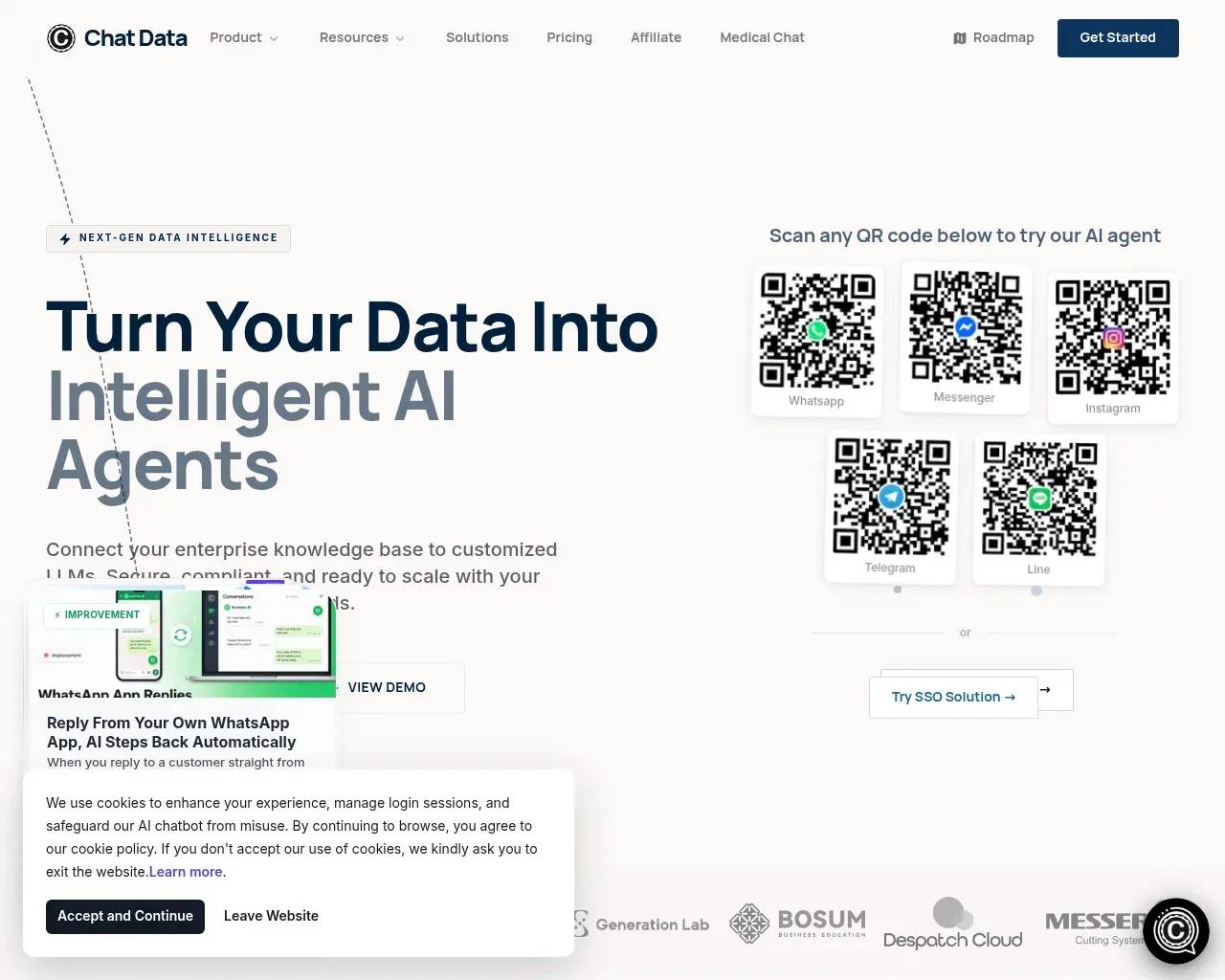
Chat Data is a platform for building AI support agents from your own knowledge. You feed it documents (.pdf, .txt, .html, .docx), pasted text, or a website link it scrapes, and it builds an agent that answers from that material. You then deploy the agent as an embedded widget, through an API, or into a messaging channel. The company is unusually specific about where the data sits: its FAQ states that servers are located in Switzerland, with data physically stored there on Oracle Cloud infrastructure and file blobs in Azure Blob Storage. For a European buyer weighing data-residency rules, that's a more concrete answer than most vendors give.
The channel list is long and it's the part the homepage leads with: a widget for your site, plus WhatsApp, Slack, Messenger, Telegram, Line, Instagram, Discord, and commerce platforms like Shopify, WooCommerce, Magento, and Prestashop. You can also wire it into automation layers — Zapier, Make, n8n — and into Zendesk for support teams. If "meet the customer where they already are" is the goal, the breadth here is genuine rather than aspirational.
Where it tries to stand apart
Two design decisions separate Chat Data from the crowd of train-a-bot-on-your-docs tools.
The first is how much of the backend it lets you own. Beyond training on your data, you can point the chat widget at your own model endpoint — bring-your-own backend — so the widget is just the front end for whatever you're already running. The company openly encourages this, noting it minimizes load on their own compute. That's a developer-friendly stance you don't often see from no-code chatbot vendors, and it makes the widget useful even to teams that have already built their own model.
The second is the integration surface. Chat Data leans hard into MCP (Model Context Protocol), advertising access to 834 connected apps and over 10,000 tools so an agent can pull context from Gmail, Google Drive, Notion, HubSpot, calendars, and analytics rather than answering from a siloed document set. Around that sit the features you'd expect from a maturing platform: a visual workflow builder driven by natural-language prompts, real-time voice replies, multi-modal image and file inputs, interactive UI elements like charts and carousels, SSO, and the option to rebrand and resell the agent as your own.
The compliance angle most rivals skip
The clearest differentiator is the medical vertical. Chat Data runs pre-trained Medical Chat models for both human and veterinary use, and frames them around HIPAA compliance — encrypted handling, signed Business Associate Agreements, and, per its own FAQ, no chat-history retention for medical workflows. The site points to BAAs with both OpenAI and Anthropic, alongside GDPR and SOC 2 references.
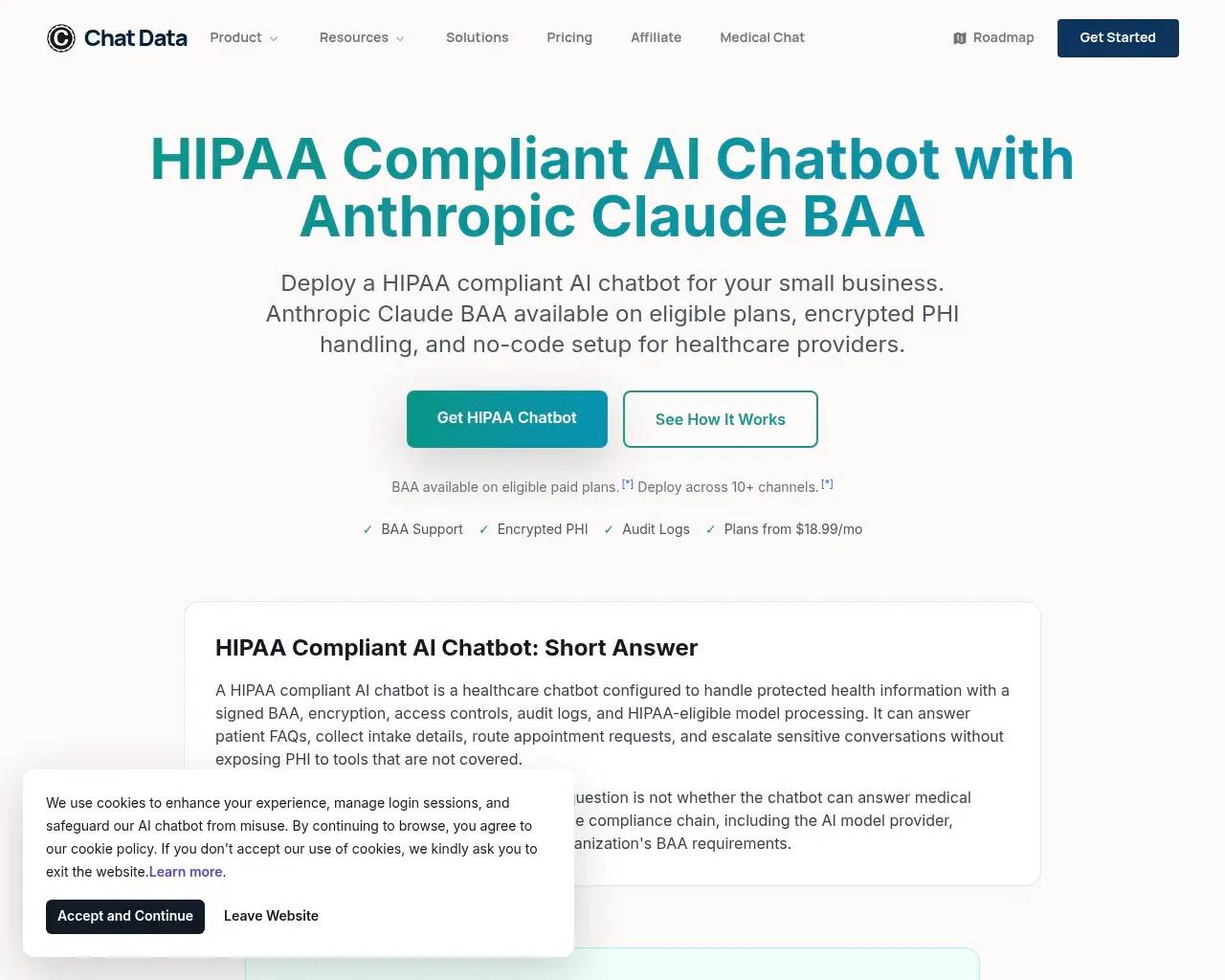
Most no-code chatbot builders simply don't go near protected health information, so for a clinic, a telehealth startup, or even a vet practice, this is the feature that turns Chat Data from "one of many" into "one of few." The important caveat: the BAA is available on eligible paid plans, not the free tier, so a healthcare buyer is committing to a paid relationship from the start.
Pricing
Chat Data publishes four tiers plus a custom one, billed on a message-credit model.
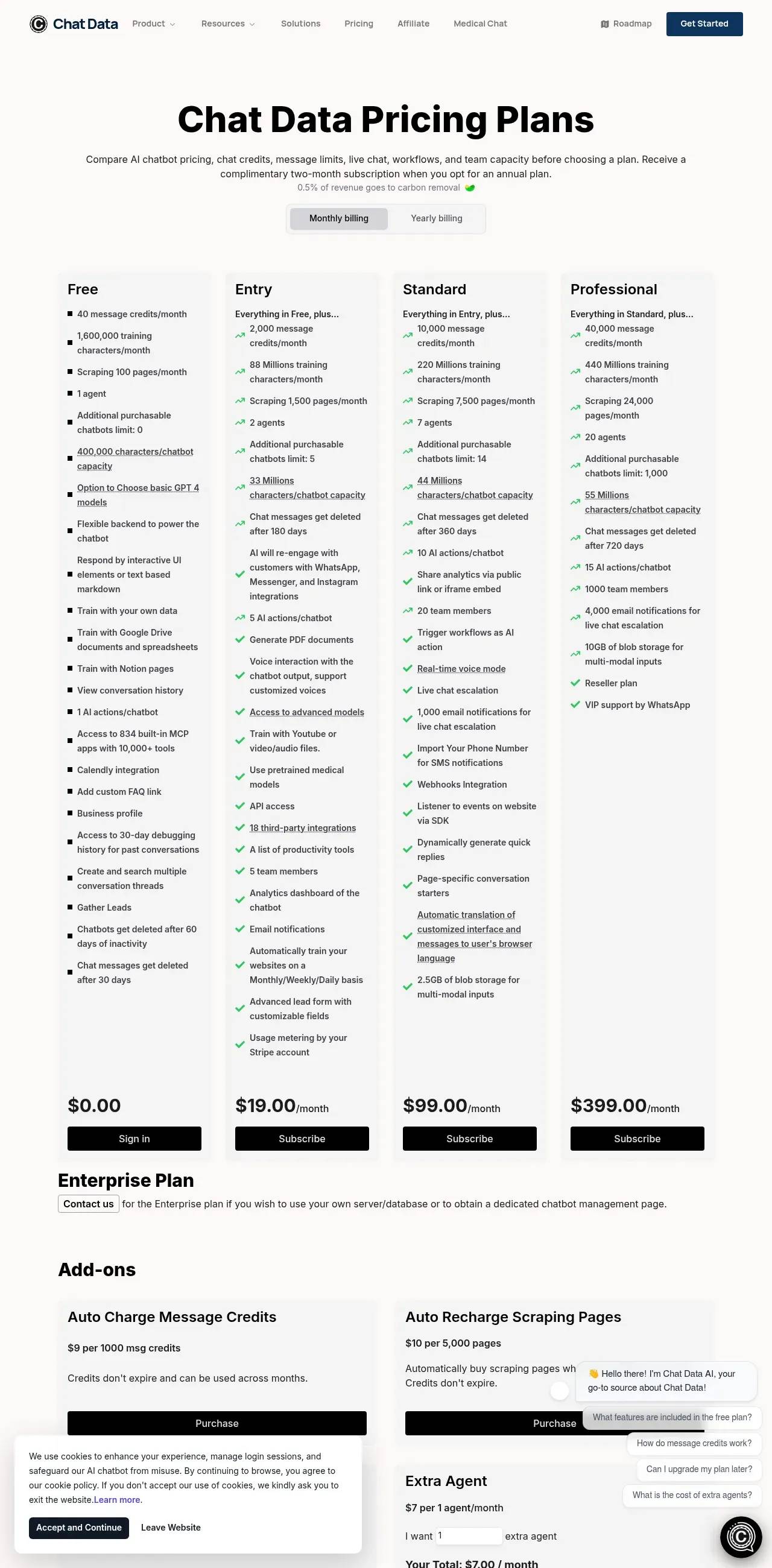
- Free — $0: 40 message credits/month, 1 agent, 100 scraped pages/month, basic GPT‑4 models. Enough to kick the tires, not to run a support desk.
- Entry — $19/month: 2,000 credits, 2 agents, advanced models, voice interaction, pretrained medical models, API access, and a handful of team seats.
- Standard — $99/month: 10,000 credits, 7 agents, real-time voice mode, webhooks, and — notably — live chat escalation from AI to a human.
- Professional — $399/month: 40,000 credits, 20 agents, reseller/white-label, and priority support.
- Enterprise — custom: for teams that want their own server or database.
Annual billing throws in roughly two months free, and the company says 0.5% of revenue goes to carbon removal. Two things to read carefully before committing. First, the credit model: 40 free credits is a demo allowance, and even Entry's 2,000 can disappear fast on a busy site — overage credits run about $9 per 1,000, so map your expected monthly conversations to a tier rather than eyeballing it. Second, human handoff (live chat escalation) only appears at the $99 Standard tier; if a person stepping in mid-conversation is a hard requirement, the $19 plan won't cover you.
Who it's for — and what to check first
Chat Data fits teams that want more than a canned FAQ bot: developers who want to plug in their own backend, businesses already spread across WhatsApp and Shopify and Slack, and — most distinctively — anyone who needs a compliance-aware bot for healthcare. It's a weaker fit if you want the absolute simplest "five-minute" widget and nothing more, because the breadth here comes with a learning curve.
A couple of honest caveats beyond pricing. Independent, third-party review coverage is thin: there's a Trustpilot listing, but I found little substantial discussion on the usual review sites or communities, and the "trusted by 1000+ businesses" line is the company's own claim rather than something you can cross-check. The platform's surface area — 834 MCP apps, custom backends, workflows, voice — is powerful but is a lot to absorb for a non-technical team. As with any tool in this category, the right move is to load your real content into the free tier, ask it your hardest support questions, and see how it answers before you pay.
Sources consulted
- Chat Data homepage — product positioning, integrations, MCP ecosystem, and the FAQ on data storage and medical models.
- Chat Data pricing — current tiers ($0 / $19 / $99 / $399), credit limits, add-on credit costs, and the carbon-removal note.
- Chat Data HIPAA chatbot page — BAA support, encrypted PHI, audit logs, and the "from $18.99/mo" framing.
- Chat Data sitemap — scope of product and blog content (medical, Shopify, MCP, workflow guides).
- Hacker News (Algolia) search — the medical-chatbot subdomain and a December 2025 Show HN of an interactive visual support agent, signalling active development.
Published on: June 4, 2026
Looking for alternatives to Chat Data? See all Chat Data alternatives →
Have an AI tool of your own? Submit it below and get a free, in-depth product review article — just like this one.
Add your AI tool in seconds
Paste your URL and we'll draft the listing. You review and edit every field before submitting.
More Product Reviews:
By: AI Collection
By: AI Collection