Podify.io review: LinkedIn growth built on AI and engagement pods
By: AI Collection
At a glance
3.0 / 5
Podify.io
PaidGrowing a following on LinkedIn is mostly a grind of writing posts, hoping the algorithm notices, and watching most of them stall at a handful of views. Podify.io sells a shortcut to that first-hour visibility problem, and it does it two ways at once: a set of AI writing tools, and a network of peers who agree to like and comment on each other's posts. That second half is the part worth thinking hardest about.
What Podify actually does
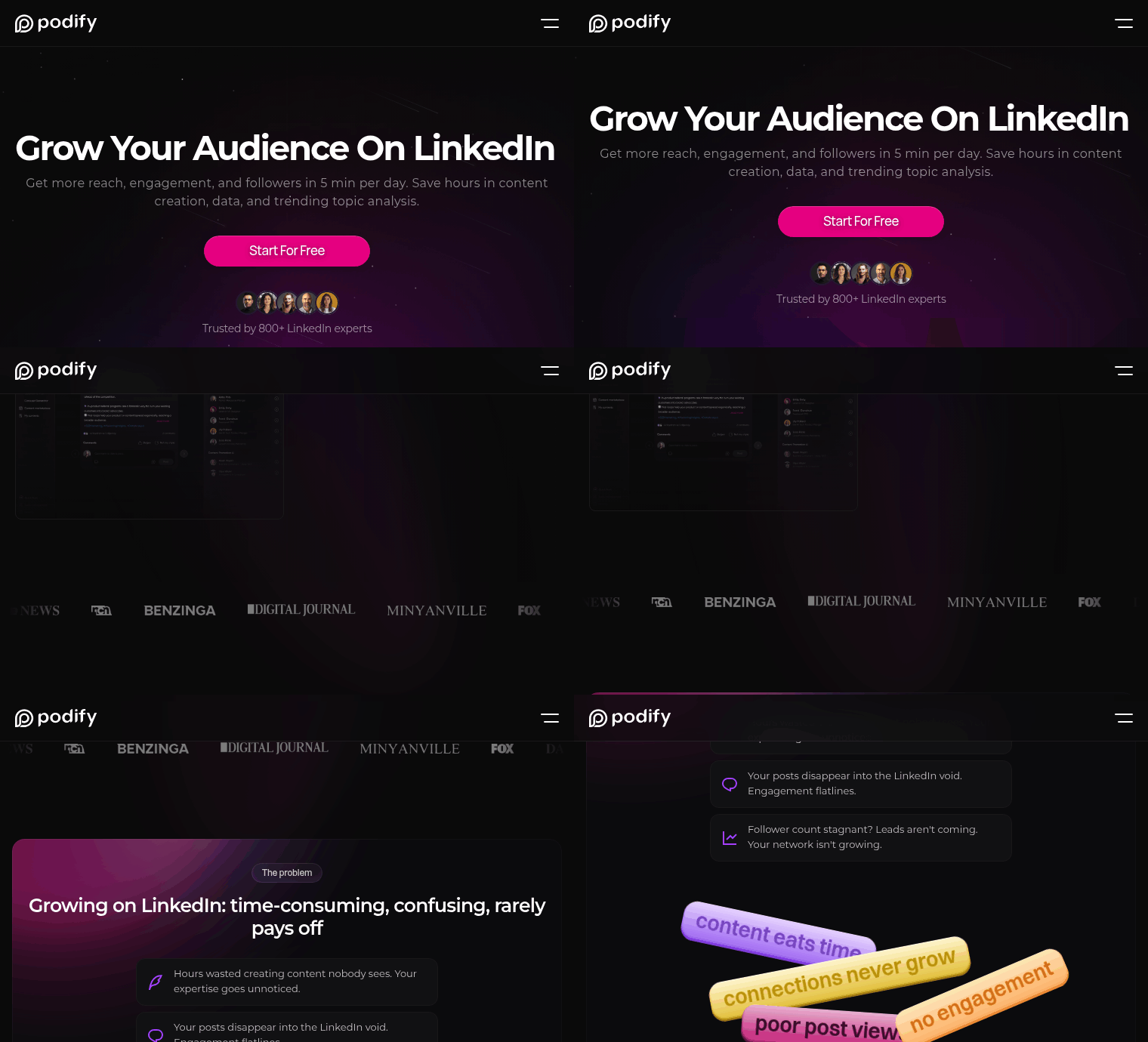
Podify positions itself as an all-in-one tool for building a personal brand on LinkedIn, and the site says it's trusted by 800+ LinkedIn experts. In practice it bundles three jobs that usually need three separate tools: making content, distributing it, and getting early engagement on it.
On the content side, it can turn a PDF, a video, or even a plain question into a draft post, pull "viral" post formats for inspiration, and rewrite your best-performing content into fresh variations so one good idea gets several outings. There's an AI comment writer that drafts replies in your own tone of voice, aimed at people who want to stay active in other people's threads without spending an hour a day doing it. A browser extension ties this back to LinkedIn so you can publish posts and comments from Podify directly.
The measurement layer is where the AI earns its keep. An "ICP Meter" scores a draft against your ideal customer profile before you post, and an engagement analysis feature looks at what's actually landing and suggests rewrites. A "Value Post" check flags whether a post says anything useful or is just filler. For anyone posting into the void and guessing, that feedback loop is the genuinely useful bit.
The communities are engagement pods
Podify's headline mechanic is what it calls Communities: small groups of members who engage with each other's LinkedIn posts. The plans are built around them. Starter lets you host 5 member communities and join 8; Growth raises that to 8 and 12; Professional gives you 12 and unlimited joins, plus access to "VIP" communities.
Call this what it is: engagement pods. The idea is that a burst of early likes and comments from your pod signals to LinkedIn's algorithm that a post is worth showing to more people. It can work, and Podify is upfront that peer engagement is the point.
It's also the feature to go in with your eyes open. LinkedIn's own guidance discourages coordinated or inauthentic engagement, and pods have been debated for years precisely because they can inflate the metrics that look good on a screenshot without reaching the people who'd actually hire you or buy from you. A reciprocal like from someone outside your field is not the same as a comment from a prospect. There's also platform risk baked in: engagement schemes are the kind of thing networks periodically clamp down on, and a growth strategy built on one is exposed to that. None of this makes pods useless, but it does mean the reach number Podify helps you grow deserves a second look before you treat it as pipeline.
The AI toolkit and where credits come in
Beyond communities, most features run on a credit balance: 50 credits on Starter, 125 on Growth, 250 on Professional. Credits are spent on the ICP Meter, engagement analysis, AI comments, and turning PDFs, videos and questions into posts, as well as buying from a content marketplace of vetted, ready-to-edit posts. Higher tiers add ICP Outreach, which pushes your content into a target audience's inbox like a newsletter, and a Data Room that turns Google Drive files into posts from a shared link.
The credit model is worth watching if you post daily. Heavy use of the AI features could run a Starter balance down before the month is out, which nudges active users toward Growth. That's a common enough pattern in this category, but it means the sticker price and the price you actually settle on can differ.
What it costs
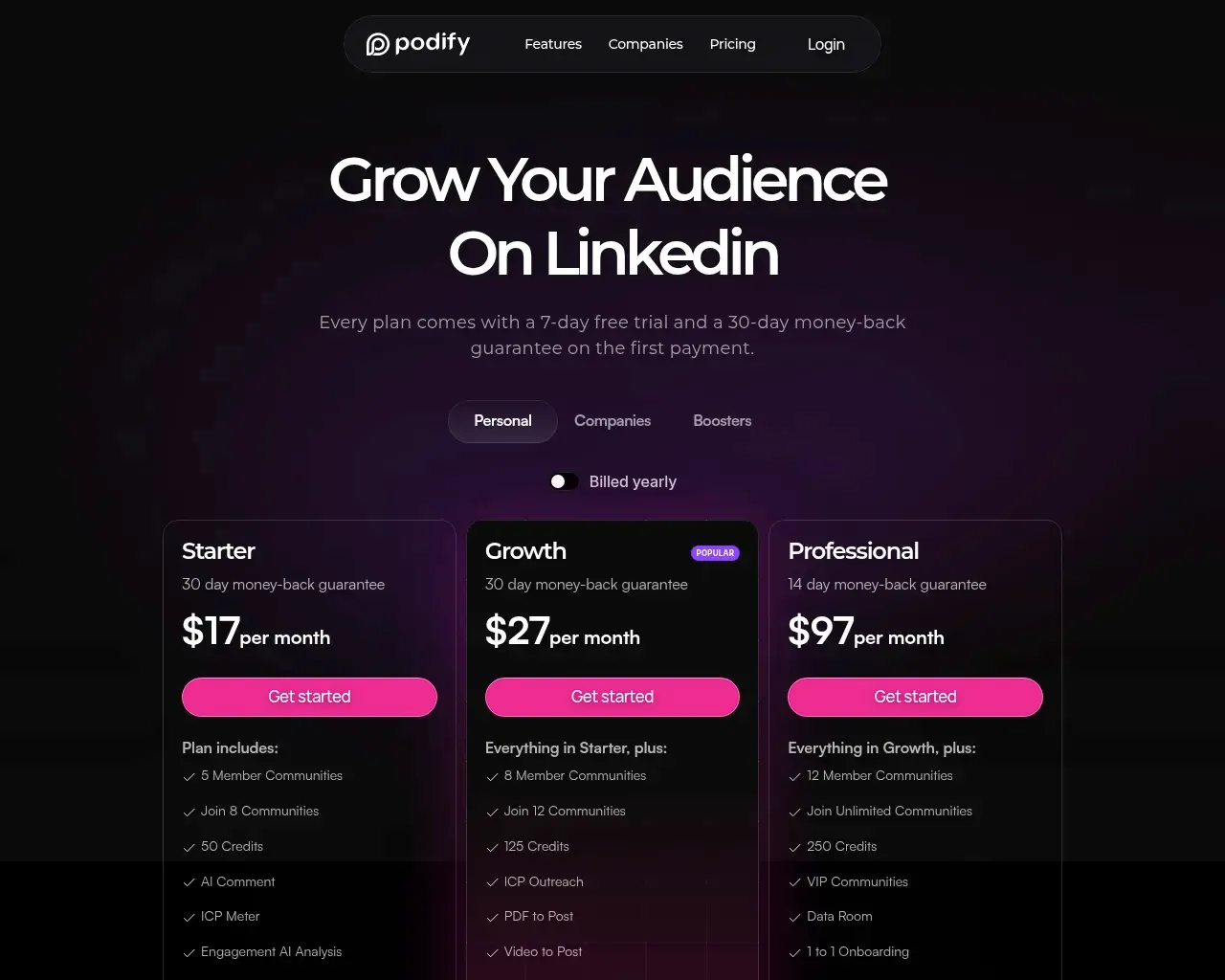
Billed annually, Starter is $17 a month, Growth $27 (the plan Podify flags as most popular), and Professional $97. Every plan comes with a 7-day free trial and a 30-day money-back guarantee on the first payment, dropping to 14 days on Professional. There are separate tracks for individuals, companies and "boosters," so agencies and teams have somewhere to land.
Two caveats on the numbers. Those are the annual-billing rates; paying month to month costs more, and some third-party listings still quote an entry price around $47, which is the kind of gap the billing toggle explains. And the 7-day trial is short for a strategy whose payoff is measured over months, though the money-back guarantee takes some of the risk out of committing.
Who it fits
Podify is aimed squarely at solo operators who live and die by LinkedIn reach: founders, consultants, freelancers, coaches and course creators trying to turn a personal profile into a lead source. The tier descriptions map to that neatly, from ambitious professionals chasing a promotion on Starter up to executives courting clients and investors on Professional. If you post occasionally or treat LinkedIn as a resume rather than a channel, most of this is more machinery than you need. If you're already posting several times a week and want tighter feedback and a distribution boost, it's built for you.
What to weigh before you buy
The honest tension in Podify is that its best parts and its riskiest part are bundled together. The AI feedback tools, the content repurposing, and the ICP scoring are genuinely useful and reasonably priced, and you could get value from those alone. The engagement communities are the growth engine, and they're also where the authenticity and platform-risk questions live. Reviews across software directories tend to land in the same place: affordable and capable, with pricing clarity and reliance on AI as the recurring gripes, and not a deep bench of long-form independent testing to lean on. There's no meaningful Hacker News discussion to consult, so the free trial is doing more of your due diligence than usual.
Overall I'd put it at 3 out of 5: a well-rounded, affordable LinkedIn toolkit whose AI features stand on their own, held back from a higher mark by a growth model that depends on engagement pods and by thin independent validation. Run it on the trial, watch whether the extra reach turns into conversations that matter rather than just a bigger like count, and you'll know quickly whether the pod trade-off is one you want to make.
Sources consulted
- Podify.io homepage — product positioning, feature set, and the "trusted by 800+" claim.
- Podify.io pricing — current tiers, credits, communities per plan, trial and money-back terms.
- Podify.io on Appvizer — third-party listing and reviewer pros/cons.
- LinkedIn engagement pods in 2026 (Podawaa) — context on how pods work and their trade-offs.
Published on: October 10, 2026
Looking for alternatives to Podify.io? See all Podify.io alternatives →
Have an AI tool of your own? Submit it below and get a free, in-depth product review article — just like this one.
Add your AI tool in seconds
Paste your URL and we'll draft the listing. You review and edit every field before submitting.