Rytr review: a cheap, fast AI writer that knows its lane
By: AI Collection
At a glance
4.0 / 5
Rytr
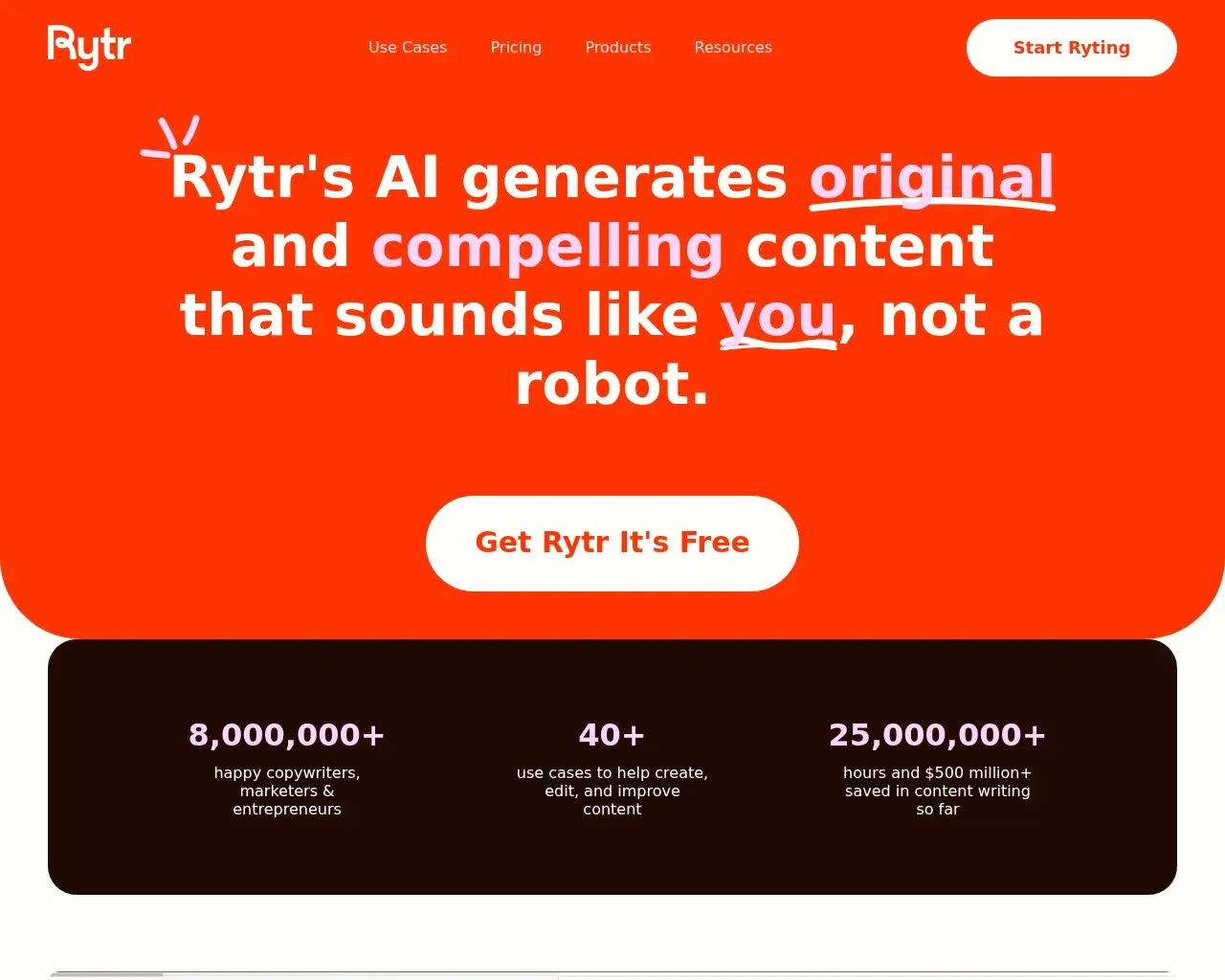
FreemiumRytr is one of the older names in AI writing, and it has stuck around by being cheap and quick rather than by chasing every new model release. It launched back in 2021, when an AI tool that could draft a passable product description felt novel, and it still sells the same core promise: paste a short brief, pick a tone, and get usable copy in seconds. The homepage sums up its pitch in one line, that its AI writes content "that sounds like you, not a robot."
For a certain kind of writer, that is exactly enough. For others it will feel a generation behind. This review works through what Rytr does, what it costs, where it holds up, and a regulatory episode that is worth knowing about before you sign up.
What Rytr is for
At its simplest, Rytr is a short-form copy generator. You choose from more than 40 use-case templates, blog section, email, product description, ad copy, social post, and so on, give it a topic and a few keywords, set one of 20-plus tones, and it returns a draft. It writes in over 30 languages, includes a built-in plagiarism checker, and can generate images alongside text. Rytr's own homepage claims more than eight million users and forty-plus use cases, and says it has saved writers 25 million-plus hours of work. Those are vendor numbers, not audited ones, but they line up with how the tool is positioned: a high-volume helper for people who need a lot of serviceable copy quickly.
The sweet spot is anything short and repeatable. Marketers grinding out ad variations, e-commerce sellers writing hundreds of product blurbs, freelancers who need a first draft to react to. If your job involves generating the same category of text over and over, Rytr removes the blank-page problem cheaply.
How the pricing works
Pricing is where Rytr makes its strongest case. There are three tiers, and the free plan is a genuine one rather than a trial.
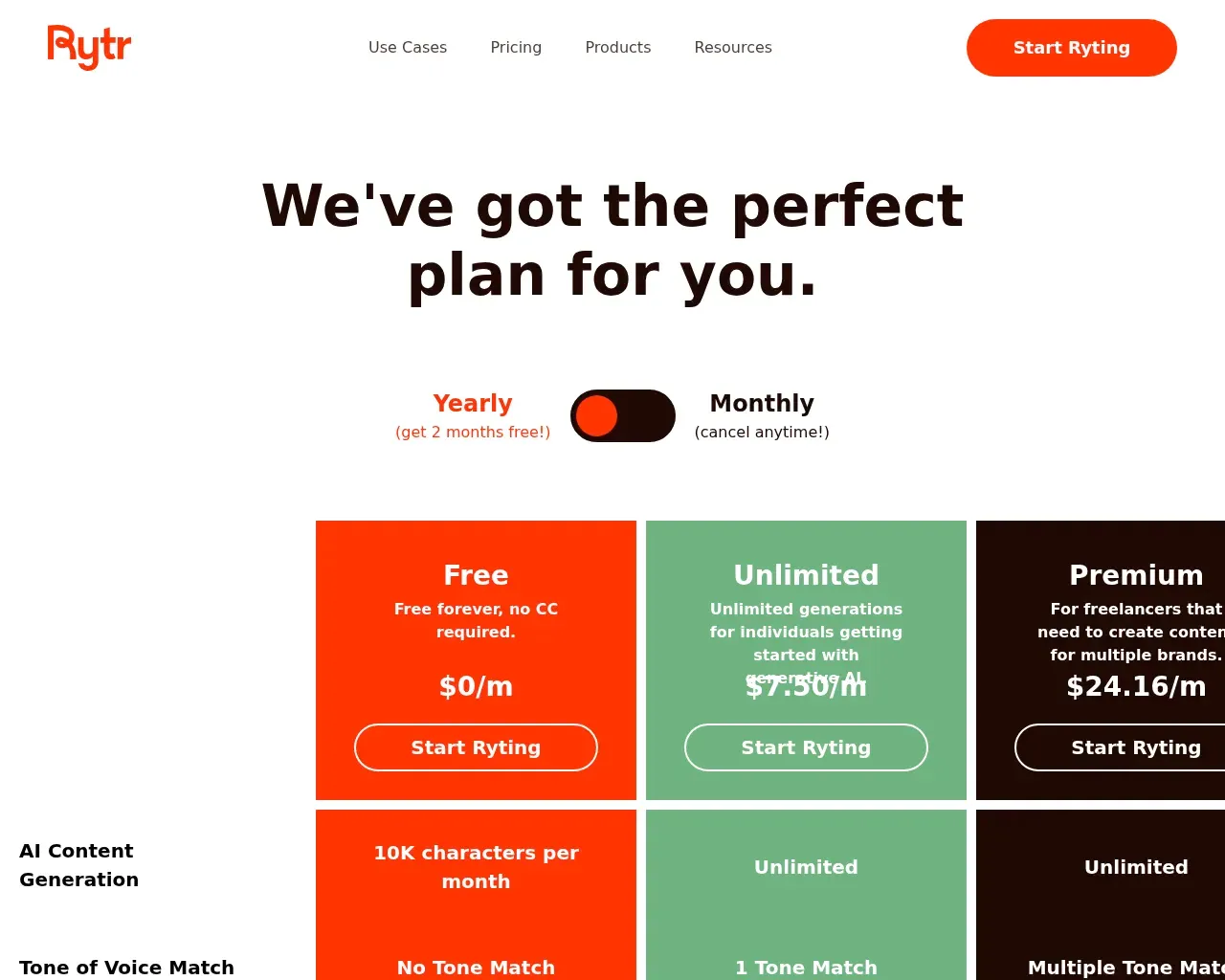
The Free plan is $0 with no credit card required and gives you 10,000 characters of generation a month, which is enough to test whether the output suits you. The Unlimited plan runs about $7.50 a month billed yearly and lifts the character cap while adding a single saved tone-of-voice profile. Premium sits around $24.16 a month billed yearly and is aimed at people writing for multiple brands, with several tone profiles. Yearly billing works out to roughly two months free versus paying monthly, and monthly plans cost more per month than the annual figures above.
For context, reviewers routinely point out that Rytr's paid entry point costs a fraction of what Jasper or Writesonic charge for their starter plans, and that price gap is the single most common reason people recommend it.
Where it holds up
The independent signal here is fairly consistent. Rytr carries a 4.7 out of 5 on G2 across roughly 800 reviews and a 4.6 on Capterra, which is a strong aggregate for a tool at this price. The praise clusters around three things: speed, a low price, and an interface that non-technical users find easy to pick up. The tone selection genuinely helps, and for short outputs the quality is usually good enough to edit and ship.
That is the honest verdict on its core job. Rytr is fast, cheap, and pleasant for short-form work, and a lot of people use it happily every day.
The caveats that matter
The complaints are just as consistent, and they cluster in predictable places. Long-form writing is the recurring weak spot across G2, Capterra and Trustpilot; the further past a few hundred words you push it, the more repetitive and generic the output tends to get. Reviewers also flag a thin integration ecosystem, with no Zapier connection, no WordPress plugin, and no PDF export, so it does not slot neatly into an existing publishing pipeline.
There is a model question too. Rytr does not publicly disclose which underlying model it runs, and several reviewers argue it has not kept pace with competitors that now sit on newer frontier models. In practice that shows up as output that feels a step behind what you would get from a current general-purpose assistant. And a minority of users report billing friction, being charged after cancelling and finding refunds slow, which drags Capterra's customer-service subscore down to about 4.0.
Back in 2023 the New York Times compared Rytr against Wordtune and ChatGPT for editing tasks, a reminder that it has always competed in a crowded field and that the field has moved quickly since.
The FTC episode
One piece of Rytr's history deserves a clear-eyed mention. In September 2024 the Federal Trade Commission filed a complaint over Rytr's "Testimonial and Review" template, one of its many use cases. The FTC alleged the feature could generate detailed reviews full of specific claims unrelated to anything the user actually entered, meaning the results would almost certainly be false once published, and that some subscribers had used it to churn out large volumes of reviews. A final consent order in December 2024 barred Rytr from offering any service dedicated to generating consumer reviews or testimonials.
The story did not end there. In December 2025 the FTC reopened and set aside that order, saying the original complaint did not meet the legal requirements of the FTC Act and that the order placed an undue burden on AI innovation, citing the administration's AI Action Plan. The reversal was reported by outlets including Compliance Week.
None of this touches Rytr's general writing features, and the specific fake-review use case is the part regulators objected to. But if you are evaluating the vendor, it is fair context: this is a tool whose most aggressive use case drew a federal enforcement action, later withdrawn on policy grounds rather than because the underlying conduct was cleared.
Who it is for
Rytr fits solo creators, small marketing teams, and e-commerce sellers who need a high volume of short copy and care more about cost and speed than about squeezing out the best possible prose. If your work is long-form, integration-heavy, or you want the sharpest model available, you will likely outgrow it or reach for something else.
Overall it earns a 4 out of 5 from me for short-form, budget-conscious writing. It does one job well at a price almost nothing else matches, and its limits are easy to see before you commit, which is about the best you can ask of a tool in this category.
Sources consulted
- Rytr homepage — product positioning, feature list, and vendor usage claims (captured in the hero screenshot).
- Rytr pricing — current Free, Unlimited and Premium plan structure and prices (captured in the pricing screenshot).
- Hacker News (Algolia search) — longevity signal, including a May 2021 listing, and pointers to the NYT and FTC coverage.
- FTC: Final order against Rytr (Dec 2024) — the enforcement action over the AI review-generation feature.
- FTC: Order reopened and set aside (Dec 2025) — the reversal on AI Action Plan grounds.
- Compliance Week — independent reporting on the original FTC settlement.
- G2 and Capterra review aggregates — 4.7/4.6 ratings and the recurring pros and cons on speed, price, long-form quality, integrations, model, and billing.
Published on: July 6, 2026
Looking for alternatives to Rytr? See all Rytr alternatives →
Have an AI tool of your own? Submit it below and get a free, in-depth product review article — just like this one.
Add your AI tool in seconds
Paste your URL and we'll draft the listing. You review and edit every field before submitting.