StoryChief review: an established content platform that went agent-native
By: AI Collection
At a glance
4.0 / 5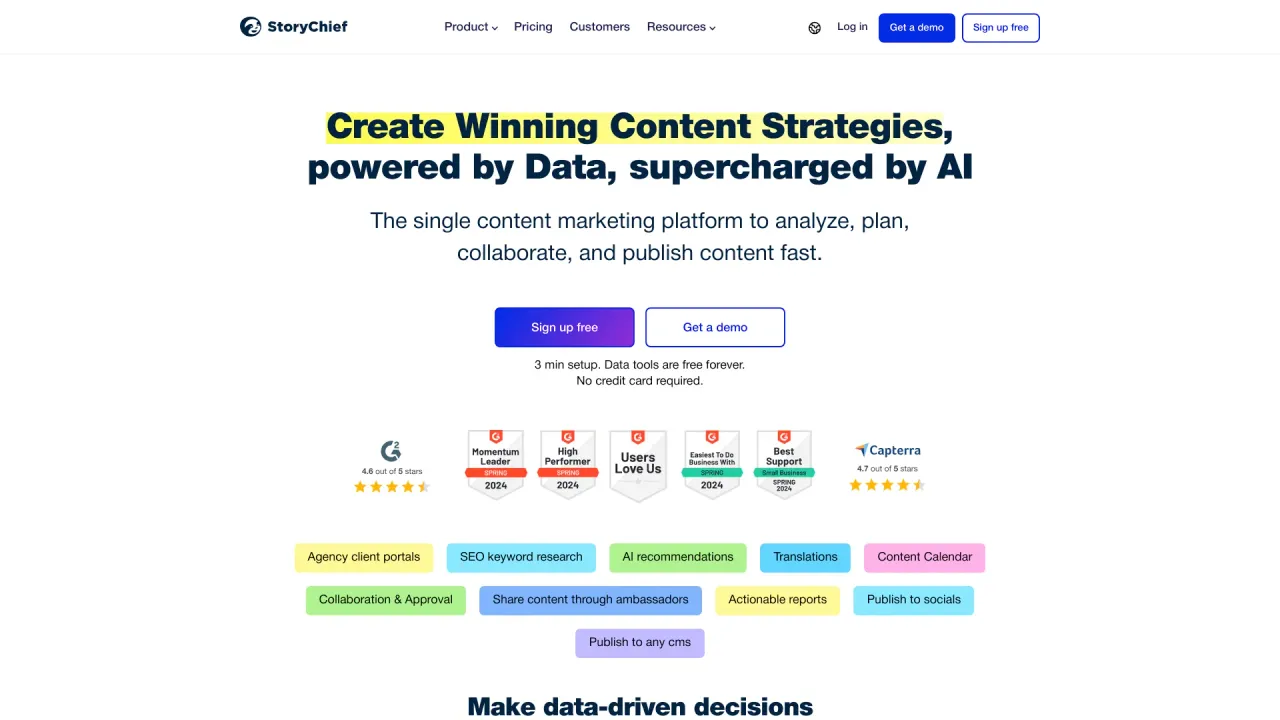
StoryChief
FreeMost content tools pick a lane. Some help you write, some schedule social posts, some grade your SEO. StoryChief has spent close to a decade trying to be the layer that ties all of that together: plan, write, get approvals, publish everywhere, then measure. Lately it has bolted an AI agent and an MCP server onto the front of that workflow. For a directory that tracks AI tools, that second part is the interesting bit: this is a mature marketing platform, not a weekend GPT wrapper, and it has decided to become agent-native.

What StoryChief actually does
The core product is a content operations hub. You draft an article once, run it through review and approval with your team or client, and then syndicate it across channels: a WordPress or Webflow blog, email, Medium, social networks, RSS. The pitch on the homepage is a single loop: plan from live data, create the content, review it, publish it everywhere, and feed the results back into the next plan. In practice that means a marketing calendar, content briefs, an SEO editor, reviews and approvals, and multi-channel publishing all living in one workspace instead of scattered across five tools.
StoryChief leans on customer stories to make the case. It cites DoorLoop adding more than 200,000 organic visitors, OHNE growing website traffic by 117%, and the agency Cureight shipping projects 50% faster across 15-plus brands. Treat those as vendor-supplied numbers rather than independent benchmarks, but they do point at the two audiences the tool is built for: in-house marketing teams and agencies juggling several brands at once.
The agent-native turn
This is where StoryChief separates itself from the average content calendar. It ships an AI Marketing Agent that takes your approved brand context (voice, audiences, content pillars) plus live data and turns it into strategy, research, briefs, copy, visuals, and full campaigns. A human reviews everything before it publishes: the agent drops drafts onto a canvas for the team rather than pushing straight to a blog. In one worked example on the product page, the agent is asked to build a Valentine's campaign, then reports back that it searched the web for trends, read the account's Search Console data, generated images, and added four drafts for review.

The part I did not expect from a platform this old is how far it goes on interoperability. StoryChief runs an MCP server, so a Model Context Protocol client such as Claude, ChatGPT, Cursor, or Zapier can create, manage, and publish StoryChief content directly. It also publishes free, installable Agent Skills that work in Claude, Cursor, ChatGPT, Windsurf, and Gemini, including a seven-step content marketing strategy skill and a content writing skill tuned for both traditional SEO and answer-engine visibility. If you already live inside an AI assistant, you can point it at StoryChief instead of copy-pasting drafts out of a chat window.
That ties into the other recent addition: an AI visibility tracker. Alongside the usual SEO tooling, StoryChief now tries to measure whether your content is getting cited in AI answers, which is the problem a lot of marketing teams are quietly panicking about as search shifts toward generated responses.
How pricing works
StoryChief no longer lists a free plan; instead every tier starts with a free trial that needs no credit card and unlocks all features and add-ons. The paid plans scale by team size and output.

Starter is $69 a month, or $59 a month billed yearly, for one user, four social channels, 25 articles a month, 15,000 AI credits, and three tracked AI-visibility prompts. Growth, the plan StoryChief recommends for small teams, is $339 a month or $279 billed yearly for three users, ten channels, 100 articles, and 25,000 AI credits, adding team tasks, employee advocacy, and AI image generation. Scale is $539 a month or $449 billed yearly for five users, 25 channels, unlimited articles, and 50,000 AI credits, adding guest writers, multilingual publishing, and AI video generation. Agencies get a separate plan priced per client workspace at $97 a month or $81 billed yearly, with unlimited users. Yearly billing saves about 17% over monthly. Two things worth noting from the pricing structure: AI usage is metered in credits, so heavy agent use has a real cost attached, and there is no longer a cheap social-only entry tier, so even a solo marketer starts at a meaningful monthly commitment.
What independent reviewers say
On G2 and Capterra the recurring praise is consistent: the publishing and syndication engine is strong, the SEO editor is good, and support gets called out repeatedly as fast and genuinely helpful. Reviewers like being able to get an article "100% SEOified" before it goes to a client, and the collaborative drafting, where multiple people can comment, correct, and push to several platforms at once, is the feature people say saves them the most time.
The criticisms are worth taking seriously before you commit. The SEO tooling is built primarily around English and reviewers report it works poorly for languages like Korean and Mandarin, which matters if you publish multilingual content. There are complaints about an aggressive no-refunds policy and friction when canceling, so read the subscription terms carefully before you commit, especially on yearly billing. And one practical workflow quirk comes up: you can't schedule a social post independently until the underlying content is published, which makes planning further ahead clumsier than it should be.
Broader web buzz is muted. StoryChief has been around since roughly 2017. It raised early funding from Peak Capital in 2019 and was posting SaaS growth updates as far back as 2018, but it has never been a Hacker News darling, and you won't find a large community shouting about it. That is neither good nor bad; it is a steady European SaaS company rather than a hype cycle.
Who it fits
StoryChief makes the most sense for a content team or agency that publishes real articles across multiple channels and is tired of stitching a writing tool, an SEO checker, a social scheduler, and an approval process together by hand. The agent, MCP server, and Agent Skills make it a strong pick specifically for teams that want their AI assistant to do the drafting inside a governed workflow, with human review before anything ships. A solo marketer can start on Starter, but at $59 a month or more it only pays off if you publish articles, not just social posts.
Overall it lands at a 4 out of 5 for its intended audience: a capable, well-supported content operations platform that has done the AI integration work thoughtfully, held back only by English-first SEO, the credit-metered AI, and a billing policy you'll want to read closely. If you mainly need a quick social scheduler, it's more platform than you need. If you run content as a real pipeline, it's one of the more complete options that also plays well with the AI tools you're probably already using.
Sources consulted
- StoryChief homepage — product positioning, workflow, and customer-story figures
- StoryChief pricing — plan tiers, per-seat costs, AI credits, and billing terms
- StoryChief AI Marketing Agent — how the agent researches, drafts, and routes work for review
- StoryChief llms.txt — MCP server, Agent Skills, and supported AI clients
- StoryChief sitemap — AI visibility tracker and competitor comparison pages
- StoryChief pros and cons on G2 — independent praise and criticism
- StoryChief reviews on Capterra — verified-user pros, cons, and pricing context
- Hacker News: StoryChief funding and SaaS growth posts — company longevity and early funding signal
Published on: October 6, 2026
Looking for alternatives to StoryChief? See all StoryChief alternatives →
Have an AI tool of your own? Submit it below and get a free, in-depth product review article — just like this one.
Add your AI tool in seconds
Paste your URL and we'll draft the listing. You review and edit every field before submitting.