Create A Marketing Funnel With AI
By: AI Collection
Business owners are constantly searching for ways to optimize their customer journeys and boost conversion rates in today's fast-paced digital landscape. The marketing funnel has become an essential tool for guiding potential customers through the sales process. AI has made the creation and optimization of marketing funnels and over marketing more efficient and effective than ever before.
All industries are predicted to be significantly impacted by the use of AI in marketing. McKinsey Global Institute believes that the marketing and sales function alone might benefit from artificial intelligence (AI) to the tune of $1.4 trillion to $2.6 trillion. This demonstrates the enormous potential of AI to completely transform the way companies develop their marketing plans.
Understanding the Basics of Marketing Funnels
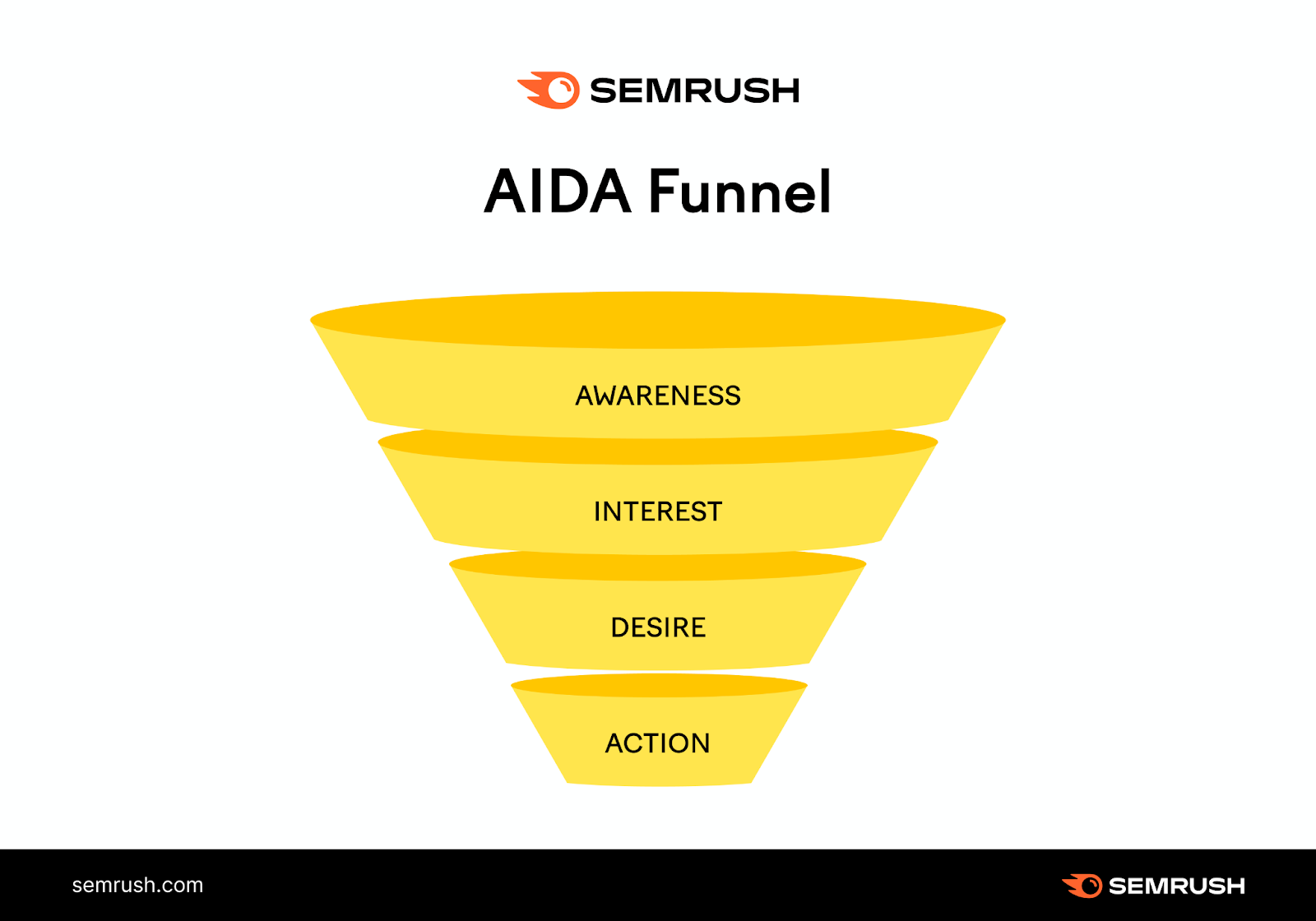
First things first, let's talk about marketing funnels. Imagine a giant funnel (not the kind you use for baking, though). At the top, you've got a whole bunch of potential customers who are just starting to learn about your brand. As they move through the funnel, they go through different stages:
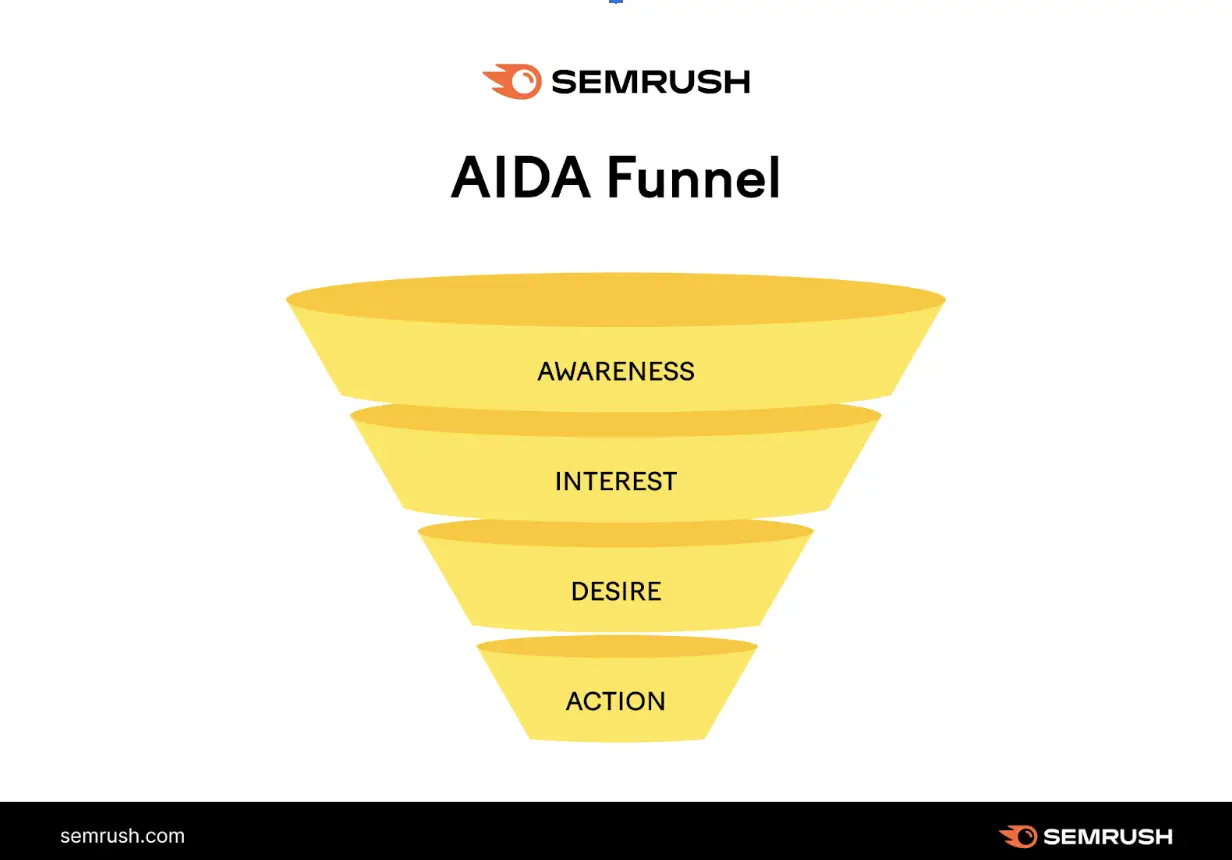 Image source: SEMrush
Awareness (Top of the Funnel or ToFu):
Potential customers become aware of your brand, products, or services. Your goal is to attract them and generate interest.
Interest (Middle of the Funnel or MoFu):
Potential customers actively seek more information about your offerings. Your goal is to nurture leads and provide valuable information.
Desire (MoFu):
Potential customers have a strong interest in your products or services and are considering a purchase. Your goal is to persuade them that your offerings are the best solution.
Action (Bottom of the Funnel or BoFu):
Potential customers are ready to make a purchase and become paying customers. Your goal is to make the purchasing process smooth and seamless.
Your job is to guide these folks through the funnel, giving them incredible content and experiences that keep them engaged and excited about what you have to offer.
It's crucial to remember that the marketing funnel isn't always a straight line. Before deciding to buy, customers may move back and forth between stages of the funnel, entering at different points. This is where artificial intelligence (AI) may be quite helpful in interpreting consumer behavior and offering tailored experiences at every funnel level.
The Power of AI in Marketing Funnels
Artificial intelligence has completely changed how companies handle marketing funnels. Businesses can now offer their clients highly customized experiences by utilizing AI to deliver content and messaging that speaks to their unique needs and interests.
Businesses may more correctly score and classify leads thanks to AI-driven predictive analytics, which makes sure that resources are directed towards the most promising prospects. Furthermore, by continuously analyzing data and optimizing the funnel depending on user behavior, artificial intelligence (AI) can assist in increasing conversion rates and client engagement.
Processing massive amounts of data and extracting insightful information is one of AI's key advantages in marketing funnels. AI algorithms can spot patterns and trends in consumer data that may not be immediately apparent to marketers by examining information such as demographics, behavior, and preferences. This helps companies to optimize their marketing campaigns for optimum impact and make data-driven decisions.
Businesses can easily design personalized forms, quizzes, and surveys that gather vital consumer data with the help of AI solutions like AI Form Builder. These solutions analyse consumer feedback using artificial intelligence algorithms to produce useful insights that can enhance marketing campaigns and enhance the overall customer experience.
Implementing AI at Each Funnel Stage
In order to get the most out of AI in your marketing funnel, you must know how to apply AI-powered tactics at every turn.
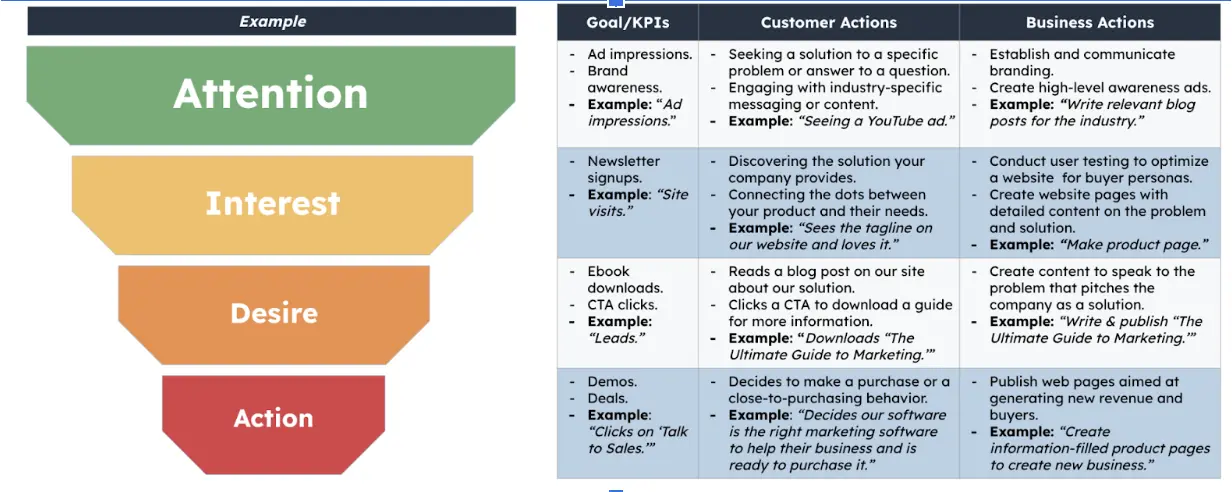 Image Source: Hubspot
Awareness Stage
AI can help with the front end of the funnel by helping you to create optimized content that engages your target audience and ranks highly in search engines. The most pertinent keywords and subjects to target can be found with the aid of AI-powered solutions, ensuring that your material is seen by the right people at the right moment. This is also the time to implement chatbots, which may direct potential customers to pertinent content and instantly respond to frequently asked inquiries.
Interest & Desire Stage
Email marketing using AI-powered personalisation and product suggestions at the middle of the funnel can cater to individual tastes and behavior. In order to maximize open rates and engagement, artificial intelligence (AI) algorithms can evaluate customer data to identify the best subject lines, messaging, and timing for every email campaign.
At this point, dynamic pricing driven by AI can also be used to instill a sense of urgency and persuade potential buyers to buy. Artificial Intelligence (AI) can assist in determining the ideal price point for any good or service by examining variables including demand, competition, and consumer behavior.
Action Stage
While customized upsells and cross-sells can raise average order value, an AI-optimized checkout process at the bottom of the funnel can expedite the purchasing process. With the use of client purchase history and behavior analysis, artificial intelligence (AI) can suggest related goods and services, hence boosting the possibility of further sales.
Sales teams may focus on prospects who have the highest conversion rates by prioritizing their eusests and utilizing AI-powered predictive lead scoring to discover the most promising leads. At this point, chatbots can also be used to assist clients with last-minute purchases, offer immediate customer service, and respond to commonly requested queries.
Best Practices for AI-Driven Funnels
Take into account these best practices to make sure your AI-powered marketing funnel succeeds:
- Establish measurable objectives and key performance indicators (KPIs) to assess the success of your AI-driven tactics.
- Give data security and quality top priority since maintaining consumer information security and accuracy is essential.
- Select the appropriate AI tools for your company's needs, like the AI form builder from involve.me, which has a feature-rich interface and an easy-to-use interface.
- Keep an eye on and refine your AI-powered funnel on a constant basis using consumer feedback and data insights.
- Make sure your AI-powered tactics complement your brand identity and overarching marketing objectives.
- Give customers choice and transparency over how their data is used and the experiences they have with AI-powered products.
Real-world examples
Many businesses have successfully implemented AI-powered marketing funnels to drive growth and improve customer engagement.
For instance, the writing assistance programme Grammarly uses AI to tailor email content according to the user's preferences and writing style, which raises click-through rates by 40%.
Leading beauty retailer Sephora has effectively improved its marketing funnel with AI. Sephora offers customers personalized experiences and recommendations at every point of the funnel through the use of AI-powered chatbots and virtual try-on features. Customer loyalty has improved, engagement has increased, and conversion rates have increased as a result.
An additional instance is The Hustle, a daily newsletter that achieves a 60% rise in open rates by utilizing artificial intelligence (AI) to segment its readership and deliver personalized content.
AI-powered marketing funnels have also helped affiliate programmes by matching products with the best affiliates and optimizing commission structures based on performance data.
Conclusion
AI's effect on marketing funnels will only increase in importance as it develops further. Businesses may generate long-term growth, enhance conversion rates, and provide highly customized consumer experiences by utilizing AI-powered tools and tactics.
Businesses need to adapt and use AI to their advantage in order to remain competitive in the modern digital landscape. Businesses may better understand their customers, provide more relevant and engaging experiences, and eventually improve business results by putting AI-powered strategies into practice at every point of the funnel.
Companies who adopt AI and apply it to their marketing funnels will be well-positioned to prosper in the long run as the marketing landscape keeps changing. Businesses can seize fresh growth prospects, forge closer bonds with their clients, and gain a competitive edge in their particular industries by staying ahead of the curve and utilizing AI.
Published on: May 7, 2024