Chatbit review: a no-code AI chatbot builder for small business websites
By: AI Collection
At a glance
3.0 / 5
Chatbit
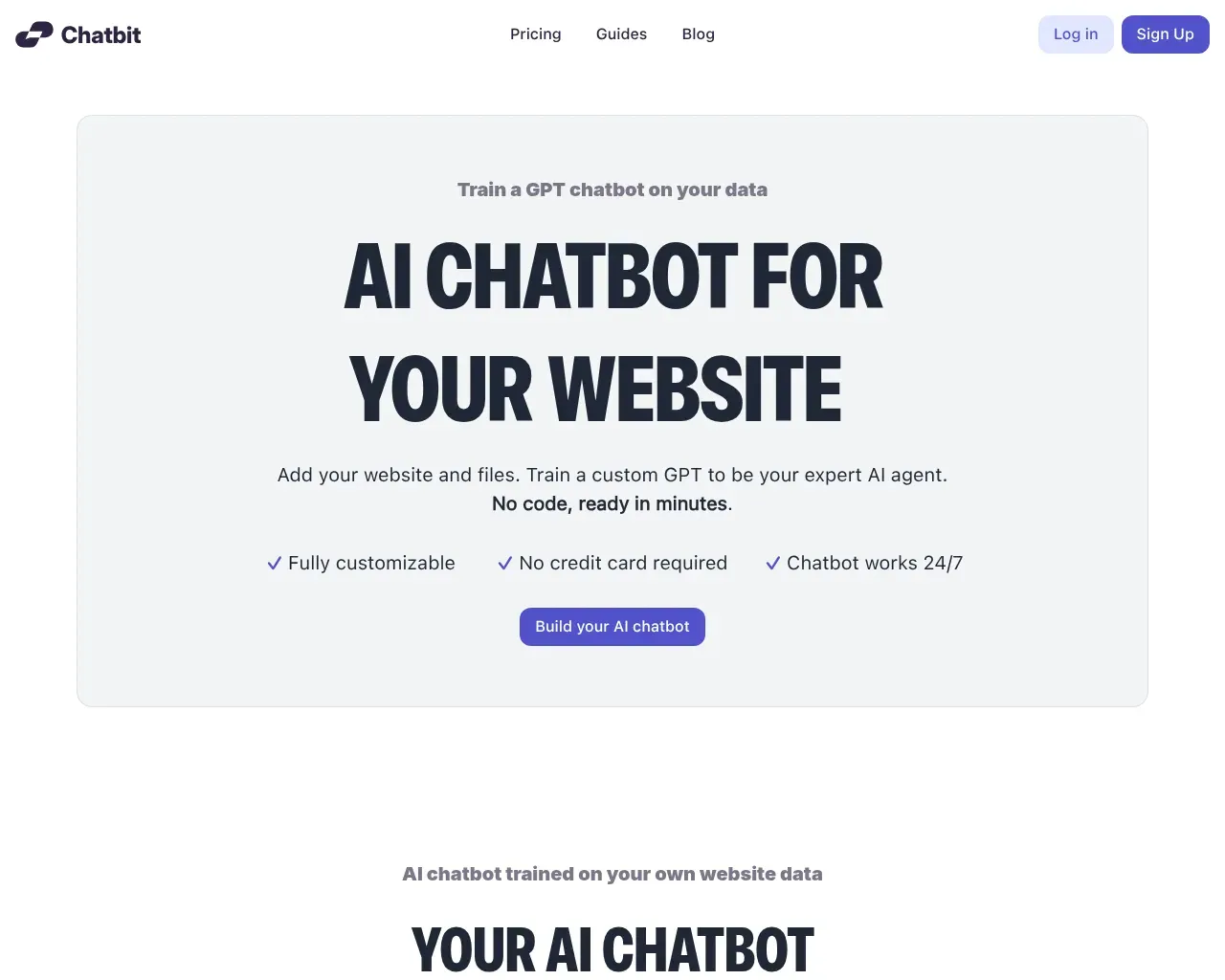
FreemiumIf you run a small business website, you have probably thought about adding a chatbot that can answer "do you ship to Canada?" at 2 a.m. without you writing a single support reply. Chatbit is built for exactly that job: point it at your site and a few documents, and it trains a ChatGPT-style bot that lives in a corner of your pages and talks to visitors. It is cheap, it installs in minutes, and it collects leads while it works. It also sits in one of the most crowded corners of the AI market, so for a buyer it comes down to whether the basics are done well and where the rough edges show.
What you actually get
The setup is the selling point. You add your website URL, upload files (PDF, TXT, DOC, DOCX), paste raw text, or fill in a Q&A section, and Chatbit builds a bot trained on that material. There is no code to write beyond a single embed snippet, and you can also share the bot as a standalone link. It supports up to 11 million characters of context on the paid plans, which is far more than most small sites will ever need.
Once the bot exists, the customization is straightforward: colors, position, logo, name, and custom CSS, plus a personality slider that trades creativity against precision. You can restrict the bot to your own domains, turn on guardrails so it refuses off-topic prompts instead of behaving like a free ChatGPT window, and run several separate bots for different sites or use cases. Chatbit advertises installs on Shopify, WordPress, Squarespace, and Framer, and it answers in roughly 85 languages out of the box because it rides on OpenAI's models.
Lead capture is the point
Plenty of tools can answer questions. Where Chatbit pulls its weight for a small business is the lead side. Every plan, including the free one, can collect a visitor's name, email, and phone number during a conversation, and the tool delivers those leads to you daily. An inbox lets you read the actual chats, and when the bot gives a weak answer you can correct it and save the fix straight into the Q&A training data, so the next visitor gets the better response. That loop, chat then read then correct, is the practical difference between a bot you set and forget and one that slowly gets more useful.
What it costs
Pricing is message-based and starts at nothing. The free Starter plan gives you 100 messages a month, one chatbot, and a 40k context limit. Core at $19 a month lifts that to 5,000 messages, two chatbots, and the full 11M context. Growth at $99 a month raises the ceiling to 20,000 messages and five chatbots and lets you remove the "Powered by Chatbit" badge, and Enterprise at $399 a month covers 50,000 messages and ten bots.
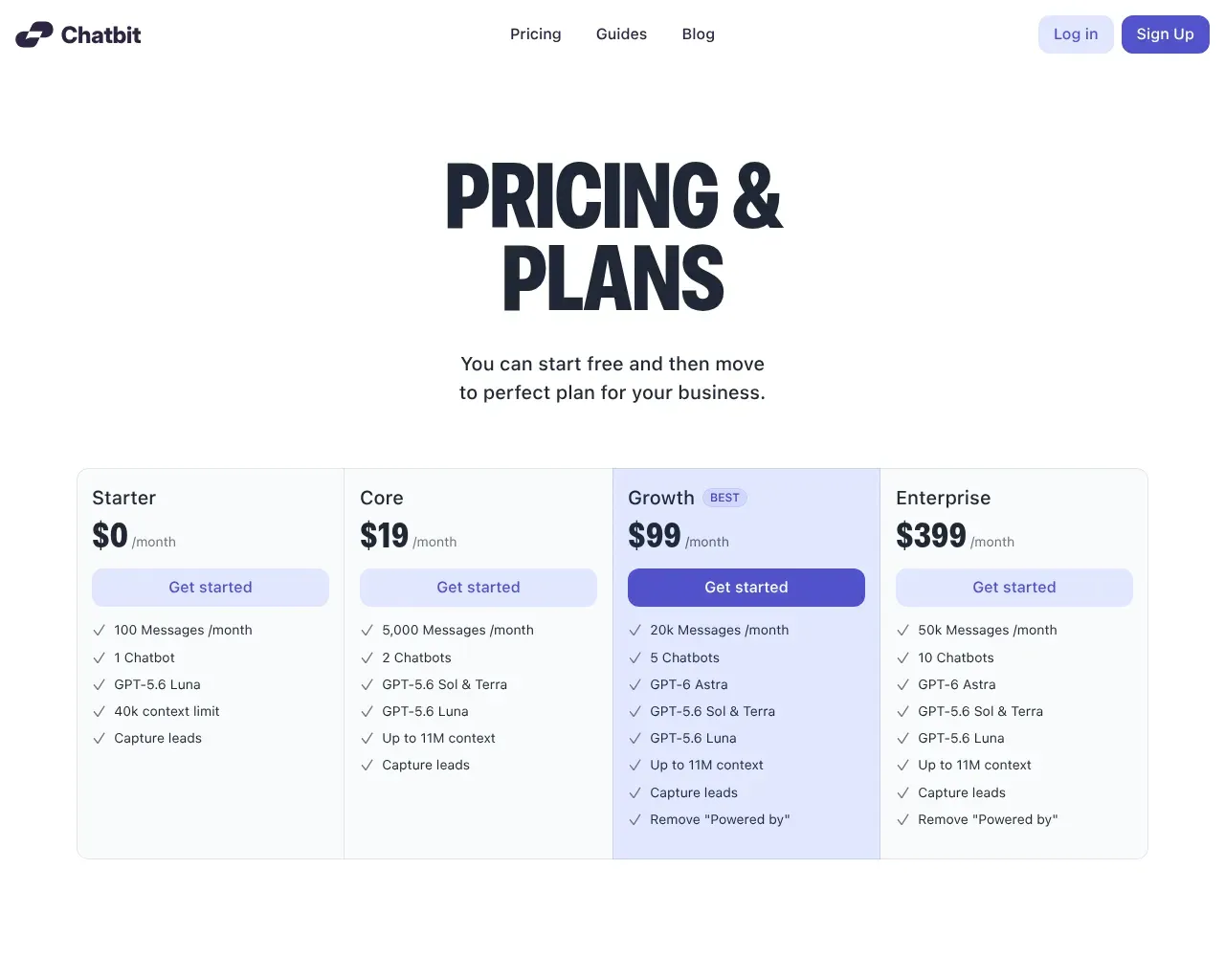
Two things are worth flagging before you commit. There is no free trial of the paid tiers, only the limited free plan, so you evaluate the higher message volumes by paying for them. And the model labels are inconsistent across Chatbit's own pages: the homepage lists GPT-4o, GPT-4o mini, and GPT-4.1, while the pricing page sells access to branded tiers with names like "GPT-5.6 Luna" and "GPT-6 Astra." The underlying capability may well be fine, but the naming makes it hard to know exactly which model each plan runs, and that is the kind of detail a careful buyer likes pinned down.
Where it fits, and where it doesn't
Chatbit is an indie product. Its developer posted it as a Show HN (Hacker News user sergiuchiriac) in April 2024, and it has stayed lean rather than chasing the enterprise crowd. Independent write-ups, like ColdIQ's review roundup, land on the same summary I did: quick to set up, genuinely useful for lead capture, and priced for people who do not want a sales call. That is a fair description of who should look at it. If you run an ecommerce store, a services site, or a small SaaS and you want a support-and-capture bot running this afternoon, it fits.
It is a weaker choice if you need a full customer-support suite with ticketing, team routing, deep CRM sync, and analytics, which is where heavier platforms justify their price. And because the "train a GPT on your website" category is so saturated, Chatbit does not stand out on features so much as on how quickly and cheaply it gets the job done. Independent validation is still thin: the Show HN drew almost no discussion, and third-party coverage is limited to a handful of tool directories.
Overall it lands at 3 out of 5. Chatbit does what it promises, the free tier and $19 Core plan make it easy to try in a real way, and the lead-capture loop is the part that earns its keep. The reasons it is not higher are the crowded field it competes in, the light independent track record, and the small transparency gaps around trials and model naming. For a solo operator or small team who values speed over depth, that is still an easy tool to recommend a look at.
Sources consulted
- Chatbit homepage — features, data sources, installation, and platform support
- Chatbit pricing and FAQ — plan tiers, message limits, model labels, supported file types and languages
- Show HN: Chatbit — founder and April 2024 launch, for longevity and traction signal
- ColdIQ: Chatbit review and AlternativeTo: Chatbit — independent sentiment on setup speed, lead capture, and the lack of a paid trial (via web search)
Published on: October 17, 2026
Looking for alternatives to Chatbit? See all Chatbit alternatives →
Have an AI tool of your own? Submit it below and get a free, in-depth product review article — just like this one.
Add your AI tool in seconds
Paste your URL and we'll draft the listing. You review and edit every field before submitting.