Elicit vs SciSpace: which AI research assistant should you use?
By: AI Collection
At a glance


Both tools promise to speed up the slog of academic research, but they solve different halves of it. If your bottleneck is screening and synthesizing a large body of literature, Elicit is the stronger choice. If it's reading individual papers closely and turning them into writing, SciSpace covers more ground for less money. The right pick depends on which of those two problems is yours.
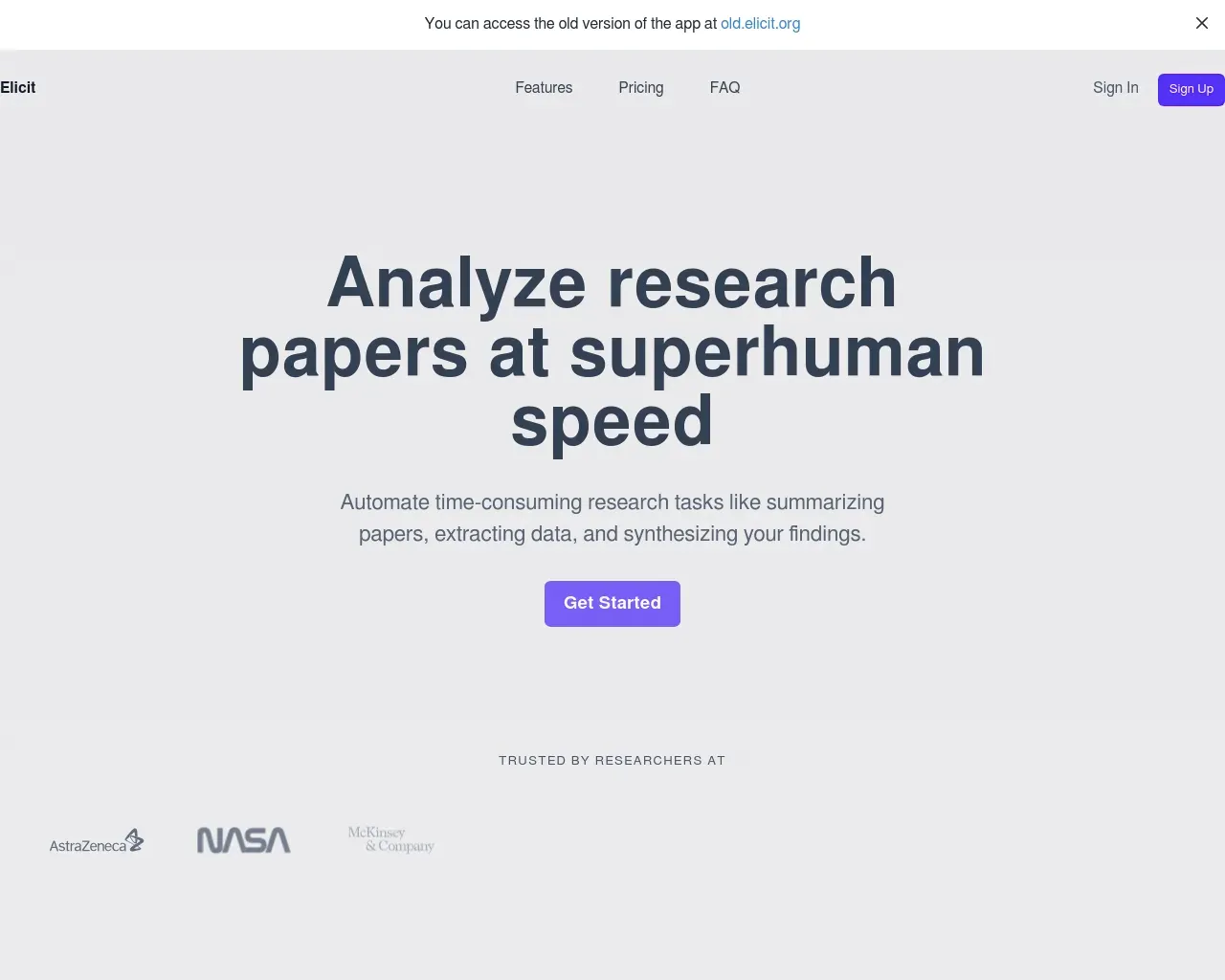
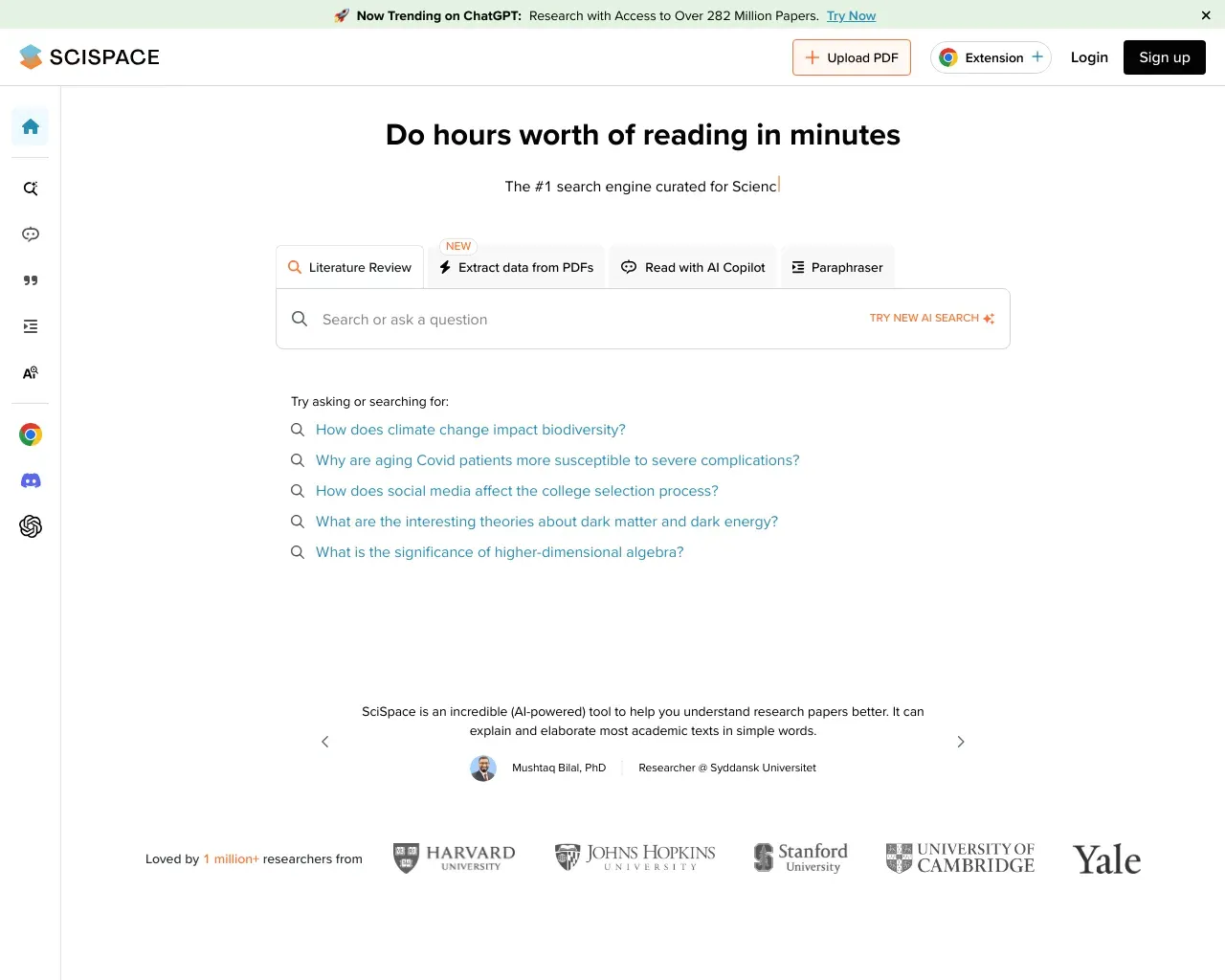
Elicit is an AI research assistant built around evidence synthesis. Its marketing line — over 7 million researchers and 8 of the top 20 pharmaceutical companies — points at where it's strongest: structured, systematic work. SciSpace, from PubGenius, is an end-to-end platform that bundles literature search, a chat-with-PDF reader, a paraphraser, a citation generator, an AI writer, and an AI detector into one subscription.
What each one is built to do
Elicit's core output is a table. You ask a research question, it finds relevant papers, and it extracts what you asked for into columns — one row per paper, with the specific findings, sample sizes, or methods you requested. On paid tiers it adds a dedicated systematic-review workflow: inclusion and exclusion criteria, threshold-based screening, and the ability to run that screening across thousands of papers (5,000 on the Pro plan, up to 40,000 on Enterprise). Independent comparisons single this out as the capability SciSpace doesn't really match, and Elicit's higher tiers advertise PRISMA-aligned screening and extraction. It searches roughly 138 million papers through Semantic Scholar and imports your library from Zotero.
SciSpace is wider by design. Its index pulls from several databases at once — Google Scholar, PubMed, arXiv, OpenAlex, and Semantic Scholar — which independent reviews put north of 280 million papers. Instead of one extraction table, its literature-review feature leans toward a narrative synthesis, and the rest of the suite is aimed at day-to-day reading and writing: open a PDF and ask questions, paraphrase a passage, generate a citation, draft a section, check text with its AI detector. There's a Chrome extension and a mobile app, so it travels off the desktop in a way a browser-only tool doesn't.
The head-to-head
Only the dimensions below are confirmed for both tools, as of October 2026:
| Elicit | SciSpace | |
|---|---|---|
| Free tier | Yes — unlimited search and summaries, chat with papers | Yes — limited monthly usage |
| Paid entry price | Pro $49/user/mo, billed annually | Premium about $20/mo, billed annually |
| Paper index | ~138M (Semantic Scholar) | 280M+ (multiple databases) |
| Systematic-review screening | Dedicated workflow, thousands of papers | Not a dedicated screening tool |
| Data extraction | Structured table, one row per paper | Narrative synthesis |
| Writing and citation tools | Limited | Writer, paraphraser, citation generator |
| Apps | Web, plus API on paid plans | Web, Chrome extension, mobile |
The pattern holds across the row: Elicit goes deep on the review-and-extract pipeline, while SciSpace spreads across the whole reading-and-writing workflow and indexes more sources.
Pricing follows the same logic. Elicit's free Basic plan is genuinely useful for search, summaries, and chatting with papers, but its systematic-review power sits behind Pro at $49 per user per month (billed annually) and Scale at $169. SciSpace starts far lower, with Premium around $20 per month billed annually and an Advanced tier near $90 that lifts usage limits, and it meters work with monthly credits rather than per-seat review capacity. For a solo student or writer, SciSpace is the cheaper way in; for a team producing formal reviews, Elicit's per-seat model is priced for exactly that kind of use.
Where each one wins
Pick Elicit if your work is evidence synthesis. You're screening a large set of papers against defined criteria, pulling structured data into comparison tables, and you want an audit trail — or, on higher tiers, PRISMA-aligned rigor, API access, and a policy that your data won't be used for training by default. It's the tool a research team or a pharma group reaches for when the deliverable is a defensible review.
Pick SciSpace if the hard part is reading and writing, not screening. It's a better everyday companion for working through dense papers, paraphrasing, managing citations, and drafting, across a larger index and at a lower price, with a browser extension and a phone app. For undergraduates, early-stage grad students, and anyone who mostly needs to get through papers and produce text, it does more for the money.
One caveat applies to both, and it's worth stating plainly: neither produces a fully PRISMA-compliant review on its own. The pre-registered search strategy, the documented dual screening, the reproducible methodology — those still come from you. These tools accelerate the work; they don't certify it.
For the full feature-by-feature breakdown, see the side-by-side comparison.
FAQ
Is Elicit or SciSpace better for a systematic literature review? Elicit. It has a dedicated screening workflow with inclusion and exclusion criteria and can process thousands of papers, which SciSpace doesn't offer in the same structured form.
Which one searches more papers? SciSpace, by a wide margin. It draws on Google Scholar, PubMed, arXiv, OpenAlex, and Semantic Scholar (280M+ papers), versus Elicit's roughly 138 million through Semantic Scholar.
Can I use either for free? Yes, both have free tiers. Elicit's free plan covers unlimited search, summaries, and chat-with-papers; SciSpace's free usage is capped by monthly limits. Trying both before paying is the sensible move.
Which is cheaper? SciSpace's entry plan, around $20 per month billed annually, is well below Elicit's Pro at $49 per user per month. Elicit's pricing is built around review capacity and seats rather than a low personal entry point.
Sources consulted
- Elicit pricing — plan tiers, paper count, systematic-review and extraction features
- SciSpace pricing — tiers, monthly credits, and the tool list
- Elicit vs. Scispace (Paperguide) — independent comparison of screening and synthesis
- Elicit vs SciSpace (CASRAI) — screening pipeline, PRISMA alignment, and index breadth
- AI Collection catalog entries for Elicit and SciSpace — baseline descriptions and verified attributes
Published on: November 4, 2026