Keploy io
Keploy — Open-Source AI API & Unit Testing for Developers.
- Category
- Workflow & Automation
- Pricing
- Free
- Alternatives
- 6 similar tools
- Last updated
- 3 weeks ago
- Source
- Official site ↗︎
AI Collection Top Picks
Workflow & Automation Category Picks


About Keploy io
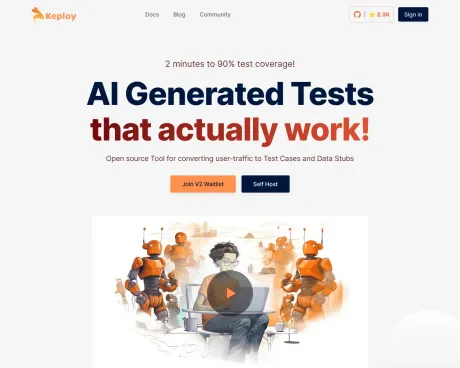
Keploy builds a Digital Twin of your production behavior — real API traffic, mocks, and dependencies — so every AI- or human-written change is verified in CI before it ships. Open source, zero code changes.
What you get
Additional Information
Keploy is an open-source, AI-powered testing platform that captures real API traffic using eBPF and replays it in Continuous Integration (CI) as deterministic regression tests, auto-generated mocks, and production-like sandboxes, all without the need for code changes. It is designed for developers and engineering teams looking to streamline their testing processes.
The platform supports a variety of programming languages including Go, Java, Python, Node.js, Rust, PHP, and Ruby, making it versatile for different development environments. Keploy allows teams to achieve 90% test coverage within minutes, thus accelerating the development lifecycle.
Keploy's core is open source under the Apache 2.0 license, with extensive community support and contributions featuring over 17,000 GitHub stars. For teams seeking advanced features such as Single Sign-On (SSO) and team dashboards, a managed cloud version is available. The basic open-source version remains free to self-host indefinitely.
Pricing plans are structured to cater to various user needs, including a free Playground tier with limited features, a Pro tier for more advanced capabilities, and an Enterprise option for organizations requiring tailored support and compliance features.
Frequently asked questions
What is Keploy io used for?
Keploy — Open-Source AI API & Unit Testing for Developers.Is Keploy io free?
Keploy io is free to use.What are alternatives to Keploy io?
Where can I get Keploy io?
Keploy io is available at https://www.keploy.io.What category is Keploy io in?
Keploy io is listed in Workflow & Automation.What is Keploy?
Keploy is an open-source, AI-powered testing platform that captures real API traffic with eBPF and replays it in CI as deterministic regression tests, auto-generated mocks, and production-like sandboxes — with zero code changes. It supports any language (Go, Java, Python, Node.js, Rust, PHP, Ruby) and any framework.Is Keploy open source?
Yes. Keploy's core platform is open source under the Apache 2.0 license with 17,000+ GitHub stars and over 1,000 contributors. Advanced features like SSO, team dashboards, audit logs, and enterprise support are available through the managed cloud at app.keploy.io.How much does Keploy cost?
Keploy offers a free Playground tier (30 test suites/month, 5 AI credits, community support), Pro at $24 per user / month with AI test generation and contract testing, and Enterprise with SOC2/SLAs and custom support. The OSS core remains free to self-host indefinitely.Is Keploy an API testing or integration testing tool?
Keploy supports both. Its AI testing platform generates API tests from specifications, requests, and application context. Its record-and-replay platform creates integration and regression tests from real traffic while virtualizing databases, queues, APIs, and other dependencies.How does Keploy work?
Keploy uses eBPF and a transparent network proxy to capture incoming requests and outgoing dependency calls without instrumenting application code. It stores the captured behavior as editable YAML tests and mocks, then replays the requests against a new build while serving recorded dependency responses.Does Keploy require code changes?
No application code changes are required for traffic-based record and replay. Keploy observes network activity using eBPF and proxy-based interception, so developers can run their applications normally while Keploy captures requests, database calls, API calls, and other supported dependencies.How does generating tests from real traffic improve coverage?
Real traffic gives Keploy the requests, responses, dependency interactions, and data states that the application actually handles. Keploy converts this behavior into reproducible tests and mocks, then uses API schemas and application context to generate additional edge cases and flows beyond the recorded examples.How is Keploy different from Postman?
Postman is primarily used to design, send, organize, and manually test API requests. Keploy can automatically generate tests from real application traffic and capture the backend dependencies involved, including databases, queues, and external APIs. This lets teams replay complete application behavior without manually recreating every request, mock, or dependency state.How is Keploy different from WireMock and other mocking tools?
Traditional mocking tools generally require developers to define and maintain expected requests and responses. Keploy records dependency interactions from actual application execution and automatically converts them into editable mocks. The same recording can include HTTP services, databases, caches, queues, and other supported network dependencies.Can Keploy verify AI-generated code?
Yes. Keploy can test developer-written or AI-generated changes against recorded application and dependency behavior. Developers and coding agents can generate tests, replay production-like scenarios, detect response or schema regressions, and verify a change before it is merged or deployed.Can Keploy run in CI/CD and Kubernetes?
Yes. Keploy tests can be replayed in CI/CD pipelines, including GitHub Actions, GitLab, and Jenkins. Local recording is available in the open-source and cloud plans, while Kubernetes and staging or production traffic capture are Enterprise capabilities.Is Keploy open source and free to use?
Yes. Keploy's core record-and-replay platform is open source under the Apache 2.0 license. Keploy also offers a free Playground for AI test generation, a paid Pro plan for teams, and an Enterprise plan for Kubernetes capture, governance, security controls, SLAs, and advanced support.
Compare Keploy io with…
Pick any tool to see a structured side-by-side: pricing, deployment, capabilities, and content policy.