- Category
- AI Agents
- Alternatives
- 6 similar tools
- Last updated
- today
- Source
- Official site ↗︎
AI Collection Top Picks
AI Agents Category Picks


About Kooko
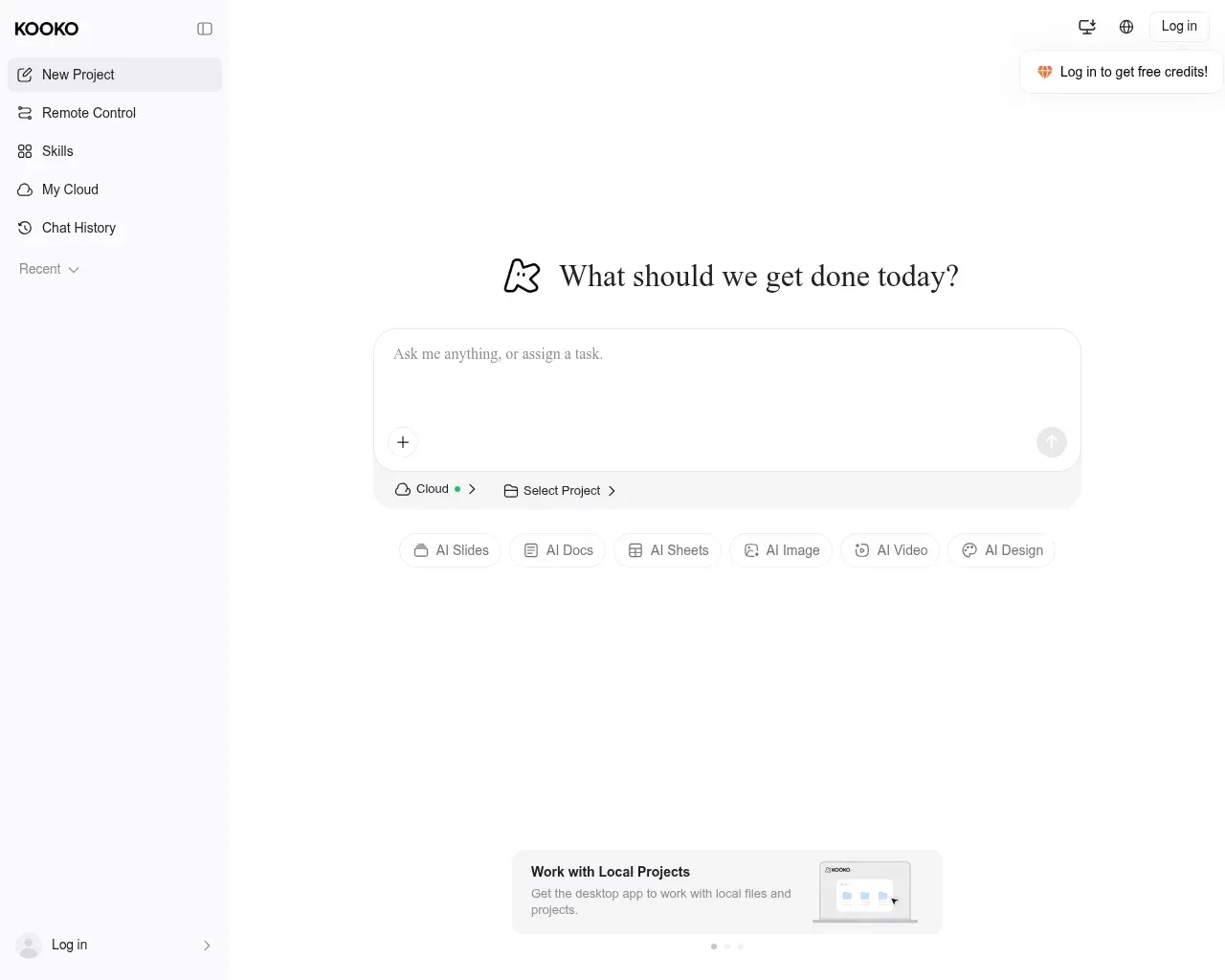
Kooko is a platform designed for automating team workflows and enhancing productivity using artificial intelligence.
What you get
Additional Information
What is Kooko?
Kooko is an AI-powered workspace that brings multiple creative and productivity tools together in one platform. It helps users create content, research information, and complete everyday knowledge-work tasks with AI.
Instead of using separate applications for presentations, images, videos, writing, transcription, and research, users can access these AI capabilities from a single workspace.
Kooko combines AI generation, editing, research, and agent-powered workflows to help users turn ideas into finished work more efficiently.
Key Features
- AI Presentation Generation
Create professional presentations from ideas, topics, or written content with AI. Kooko can help structure information, generate slide content, and turn concepts into presentation-ready decks.
- AI Image Generation
Generate images from text prompts and create visual assets for presentations, marketing, social media, creative projects, and other use cases.
- AI Video Generation
Create AI-generated videos from prompts and creative inputs for marketing, storytelling, social media, presentations, and other content workflows.
- AI Writing
Generate, rewrite, expand, summarize, and refine text for different types of content and communication.
- AI Transcription
Convert audio and speech into text with AI-powered transcription, making it easier to process meetings, interviews, recordings, and other spoken content.
- Deep Research
Use AI-powered research capabilities to explore topics, gather information, and organize findings into useful outputs.
- AI Agents
Kooko provides agent-powered workflows that can handle more complex tasks by combining AI capabilities and tools instead of relying only on a single prompt-and-response interaction.
- Multiple AI Models and Tools
Kooko brings different AI capabilities into one workspace, allowing users to choose the tools or models that best fit their creative and productivity needs.
- One AI Workspace
Kooko reduces the need to switch between separate AI applications by bringing content creation, research, and productivity workflows together in one place.
Use Cases
- Creating presentations and pitch decks
- Generating marketing visuals
- Creating social media content
- Producing AI-generated videos
- Writing and editing content
- Summarizing documents and information
- Transcribing meetings and interviews
- Conducting research
- Brainstorming creative ideas
- Creating educational materials
- Developing business content
- Automating repetitive creative and knowledge-work tasks
Target Users
Creators
Create images, videos, presentations, and other content with AI.
Marketers
Produce marketing materials, presentations, visual assets, and social media content more efficiently.
Professionals
Use AI for research, writing, presentations, transcription, and everyday productivity.
Students & Educators
Research topics, summarize information, create presentations, and develop learning materials.
Teams & Businesses
Streamline content creation and knowledge-work workflows with multiple AI capabilities in one workspace.
Why Kooko?
Kooko brings multiple AI capabilities into one workspace instead of requiring users to switch between separate tools for different tasks.
From research and writing to presentations, images, videos, and transcription, Kooko is designed to help users move from idea to finished work faster.
Frequently asked questions
What is Kooko used for?
Empowering teams through intelligent automation.Is Kooko free?
Pricing for Kooko varies — see the Pricing section for details.What are alternatives to Kooko?
Where can I get Kooko?
Kooko is available at https://kooko.ai/.What category is Kooko in?
Kooko is listed in AI Agents.
Compare Kooko with…
Pick any tool to see a structured side-by-side: pricing, deployment, capabilities, and content policy.