Interview Solver review: an invisible AI copilot for coding interviews
By: AI Collection
At a glance
3.0 / 5Interview Solver
PaidInterview Solver sells a promise most tools won't say out loud. Its homepage frames a live coding interview as two screens: the one you share, and the one the interviewer watches. The whole pitch is that a third screen, the AI feeding you answers, stays off both.
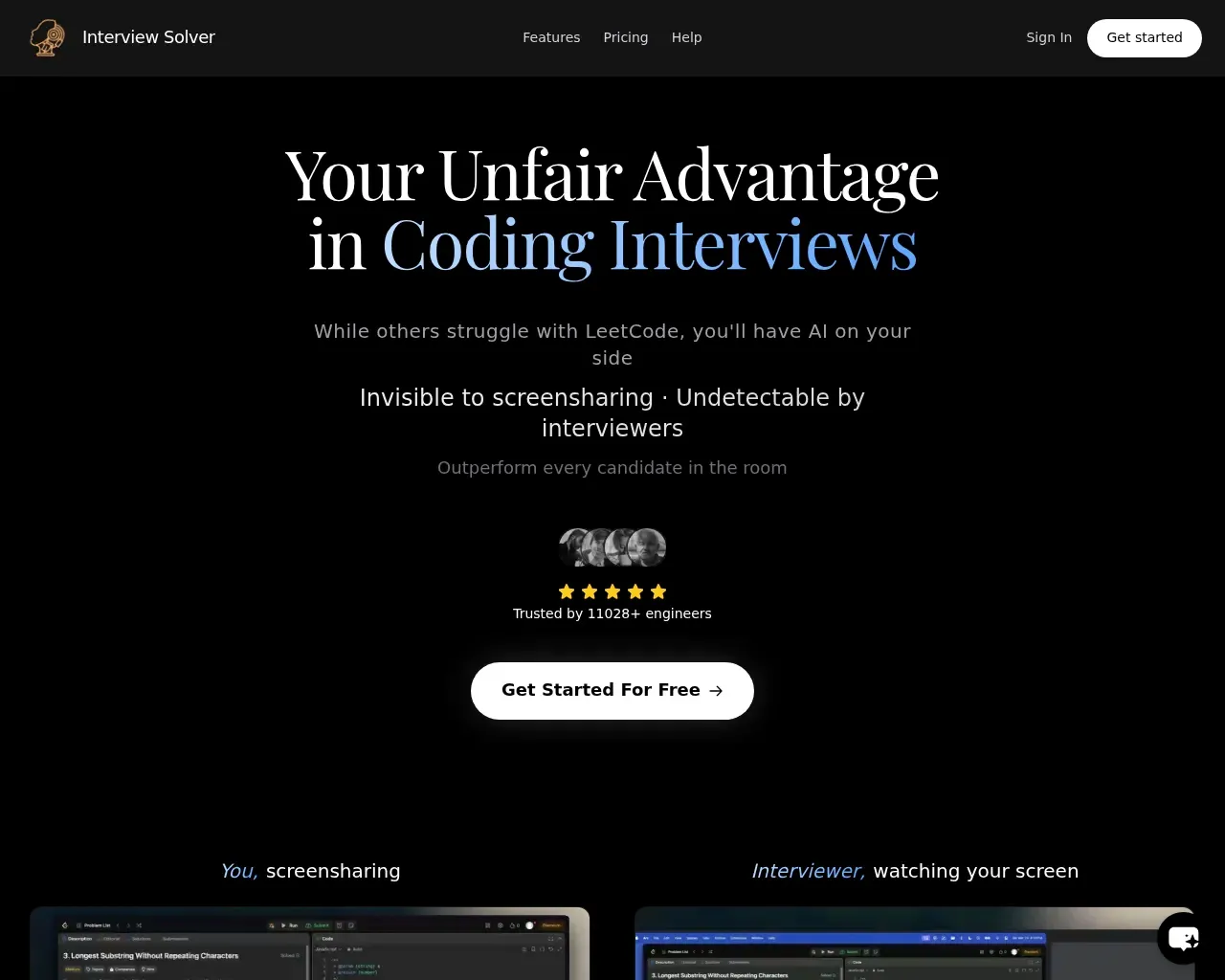
That framing tells you exactly what this is. Interview Solver is a native desktop app for macOS and Windows that runs during a live technical interview and generates answers in real time: LeetCode-style solutions, system-design structure, and complexity notes you can talk through. It is not a study tool that happens to use AI. It is built for the moment you are on the call.
What it actually does
The core loop is fast. You keep an overlay near your editor, and when a problem appears you either grab the coding window with a screengrab, highlight the prompt text, or let voice transcription capture the question as the interviewer reads it out. The model returns code, a complexity note, and a system-design sketch. Global hotkeys trigger all of it so you never alt-tab, and you can upload a resume or job description so answers stay grounded in your own background.
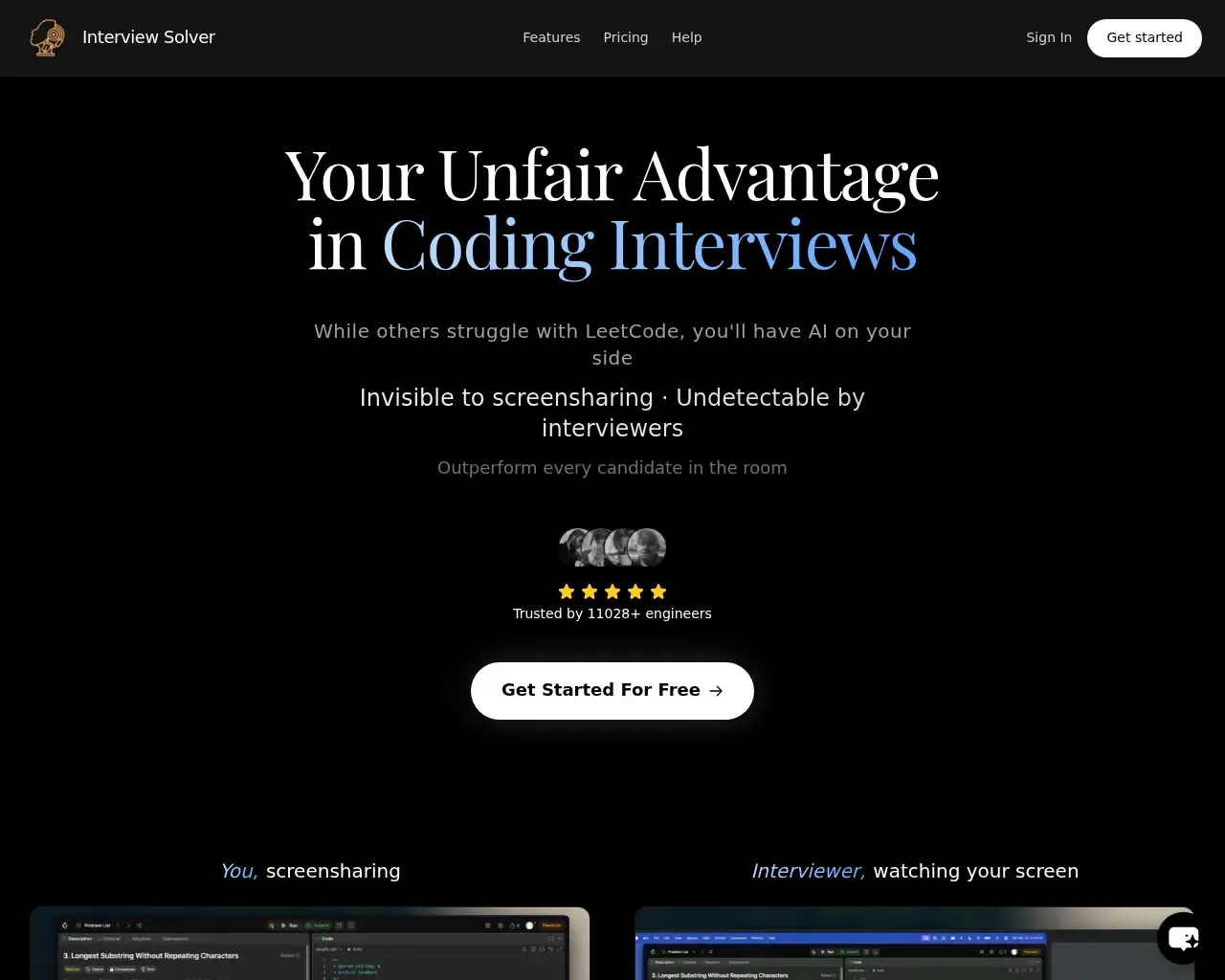
Two design choices separate it from a browser extension. Because it runs as a desktop process, the overlay can sit above Zoom, Teams, or Meet without injecting into the page the interviewer sees, and the company says it stays hidden in macOS Activity Monitor. The second is Companion mode: you drive screenshots, voice, and prompts from your phone. That exists for a specific reason. HackerRank's downloadable interview client logs keyboard shortcuts on the machine you're tested on, so the phone becomes a way to trigger help from a device nobody is watching.
Beyond the live copilot, the site is also an ordinary interview-prep hub: company-specific question banks, role tracks from frontend to DevOps, and free tools like an ATS resume checker, a STAR-method builder, a Big O cheat sheet, and a total-compensation calculator. There's even a public API with an OpenAPI spec. That half of the product is useful and carries none of the baggage of the live mode.
Pricing
Pricing is simple and, unusually, month-to-month by design.
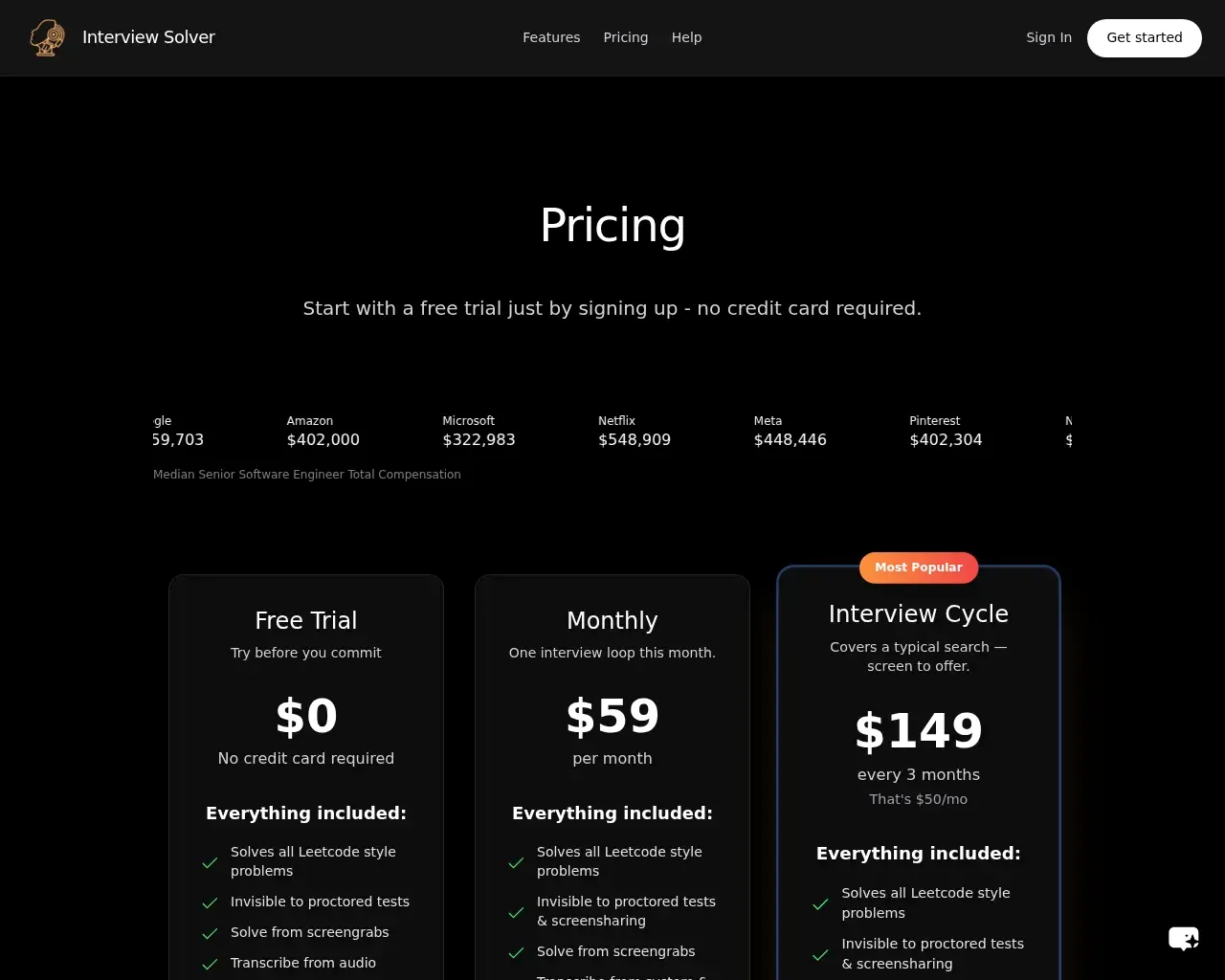
A free trial needs no credit card and gives you ten messages to test the flow. After that it's $59 a month, or a $149 "Interview Cycle" billed every three months, roughly $50 a month, pitched as covering one job search from screen to offer. There's no annual plan, which fits a product you're supposed to stop paying for once you're hired. One thing to check: older third-party listings still quote $39 to $49, so trust the site's own pricing page rather than a directory before you buy.
The part the marketing skips
The features are the easy part. The risk is the rest of the story.
Start with the ethics. Most technical interviews exist to measure how you reason and code without help. Feeding in undisclosed AI answers doesn't just bend that test, it misrepresents whose thinking the interviewer is evaluating. The practical consequences are real even where the legal ones aren't: a candidate who's caught can have an offer pulled or a process ended, and trust is hard to rebuild in a small hiring pipeline. A neutral third-party review of the tool made the same point about the long game, warning that a pass you didn't earn becomes an onboarding gap when you can't independently reproduce the reasoning that got you the job.
Then there's the claim at the center of the pitch: undetectability. The FAQ is careful enough to scope it, listing invisibility "to Zoom (≤6.16)" and browser-based recorders, which quietly concedes that a newer client or a different setup is another matter. No overlay can promise permanent invisibility, and the signals that give AI use away aren't mostly visual. Uniform response latency across easy and hard problems is the strongest behavioral tell, because human thinking takes variable time and a model doesn't, and interviewers increasingly lean on follow-ups: if you can't explain line seven, you didn't write line seven.
The bigger problem is that the ground is shifting under the whole category. Interview Solver isn't a lone tool; it's one of many openly marketed copilots, alongside Interview Coder, Final Round AI, LockedIn AI, and Cluely, all selling some version of "invisible to screen sharing." Employers have noticed. Google's leadership has signaled a return to in-person interviews for some roles, and firms like Deloitte reinstated in-person rounds for parts of their graduate hiring. A stealth tool is only as good as the interview format it beats, and that format is changing specifically to beat it back.
One last caveat: independent, verifiable evidence is thin. The testimonials are anonymous "verified customer" quotes, there's little third-party discussion confirming consistent real-world invisibility, and the company is young, online only since around April 2024.
Who it's for, honestly
Strip away the live mode and Interview Solver's prep hub and free tools are a reasonable, no-risk way to practice, and that's the part I'd point most people toward. The live copilot is a narrower call. It appeals most to candidates who feel cornered: bootcamp grads facing algorithm-heavy rounds, engineers laid off and rusty on LeetCode, people afraid of freezing on the call. It can carry you through a screen. Whether it should is a question only you can answer, with a clear view of the company's policy, the odds of a follow-up you can't fake, and the work you'll actually have to do once the interview you outsourced lands you the job.
Verdict
As software, Interview Solver does what it claims. It's quick, the desktop-process approach is clever, and Companion mode solves a real detection problem its competitors don't. As a strategy, it's a gray-area bet in a category employers are actively countering, backed by thin independent proof and carrying genuine career downside. That split is why it lands at 3 out of 5 for me: strong execution, serious caveats. Use the free prep tools freely, and think hard before you use the rest.
Sources consulted
- Interview Solver (official site) — features, positioning, the pricing tiers, and the undetectability FAQ
- Interview Solver llms.txt — product summary, plan pricing, comparison positioning, and the Companion/HackerRank rationale
- Interview Solver review, Shadecoder — neutral features and pricing analysis, ethics and detection-risk discussion, 2024 founding
- AI cheating in interviews: the 2026 state of play, Expert Hire — category size, employer responses including in-person returns, and detection-signal analysis
- Wayback Machine snapshot — first archived capture, April 2024, for longevity
Published on: October 20, 2026
在寻找 Interview Solver 的替代品? 查看所有 Interview Solver 替代品 →
Have an AI tool of your own? Submit it below and get a free, in-depth product review article — just like this one.
几秒钟添加您的 AI 工具
粘贴 URL,我们将起草列表。提交前您可以审阅并编辑每一个字段。